Tagged pedagogy

4

Care, Convenience, and Interactivity: Exploring Student Values in a Blended Learning First-Year Composition Course

Abstract

Blended learning (BL) represents one of fastest growing instructional models as an alternative to traditional face-to-face pedagogy. Convenience, interactivity, instructor availability, and classroom community are elements of blended learning environments most often associated with student satisfaction. These elements of student satisfaction all share an innate relational quality that can be understood through the framework of an ethics of care. Through ethnographic analysis, this study seeks to add to this literature by emphasizing the relational aspects of BL and the need to understand students’ experiences through the framework of care. To illustrate the use of this framework in the context of BL, this study explores how college students engage with and make sense of technology in the context of their first college course. Thematic analysis of students’ qualitative responses to interviews and a class survey revealed that students in the course largely valued elements generally associated with care, such as interactive feedback, instructor availability, and freedom of expression. Consistent with the literature, students also valued convenience and interactivity, which in this analysis were also conceptualized through the framework of care. The participants in this study were mostly non-traditional college students (e.g., low-income, minority, commuter). This article argues that understanding the effects of specific online and face-to-face practices on students’ perception of care may prove crucial in designing effective and engaging BL environments.

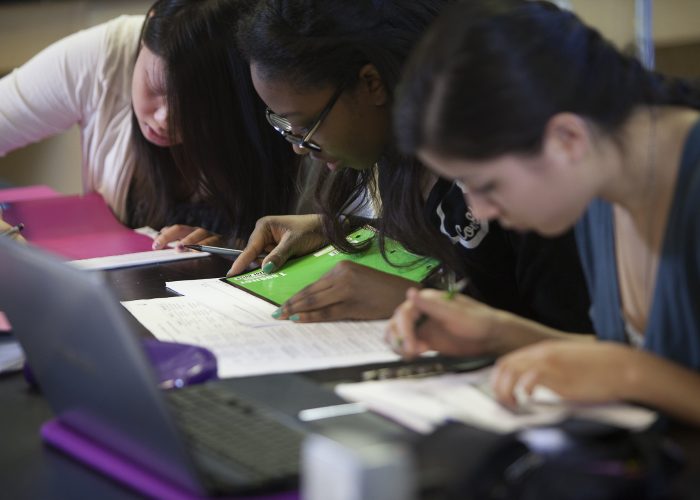
In a brand-new, tiered classroom, four semi-circle rows of desks cascaded downward, each chair bolted to the floor in front of a desk with just enough room to allow students to slip in and out. A pop-up outlet sat in front of each chair. This space implied a non-interactive pedagogy rooted in expert-to-novice transmission of knowledge. Situated in the middle of the classroom, a professor would deliver a lecture, while students would take notes diligently, many on their plugged-in devices. Group work and other pedagogies of deep student engagement would struggle to thrive in such a space. Here they sat, twenty-seven entering freshmen at one of the eight senior colleges at the City University of New York (CUNY), the largest urban, public university in the country. Paper notebooks and ballpoint pens were the only objects populating students’ desks, with the instructor’s laptop being the only visible electronic device. An ethnographer sitting in the last row, I began typing my notes, documenting these students’ first experiences with college composition and, for some, blended learning.

Blended learning (BL) encompasses teaching models that combine “face-to-face instruction with computer-mediated instruction” (Graham 2006, 5). Following recent calls to cut costs and engage students with “21st century skills,” the growth of BL instruction across educational contexts has led some scholars to call it the “new normal” of course delivery (Norberg, Dziuban, and Moskal 2011, 207). Despite its growing popularity, BL remains an understudied area compared to distance learning and face-to-face pedagogy (Graham 2013). The most impactful literature in BL is theoretical, focusing on the “definitions, models, and potential of blended learning” (Halverson, et. al 2012, 397) with the majority of empirical work focusing on student outcomes (Halverson, et. al 2012). Osguthorp and Graham (2003) identify pedagogical richness, access to knowledge, social interaction, personal agency, cost-effectiveness, and ease of revision as major goals of blended learning.

Given that BL models are relatively new, a growing segment of the empirical research on BL evaluates student satisfaction as a proxy for students’ ability to navigate new learning environments (Moore 2005). Indeed, BL models correlate positively with high levels of satisfaction (Vignare 2007; Graham 2013). Common factors contributing to student satisfaction include interactivity, convenience, flexibility, feedback, and instructor availability (e.g., Bonk, Oslon, Wisher, and Orvis 2002; Dziuban, et. al 2010; Mansour and Mupinga 2007), with interactivity, face-to-face or digital, standing out as particularly significant. For instance, Akkoyunlu and Soylu (2008) found that students, on average, identified a course’s face-to-face elements as the most significant contributors to their satisfaction. Rothmund (2008) found that learner satisfaction correlated strongly with degree of interaction. Similarly, Akyol, Garrison, and Orden (2009) found that students in BL models valued social and teaching presence.

Although student satisfaction surveys can often take the form of marketing research, interactivity and many other factors associated with student satisfaction share a critical quality: relationality. For instance, Garrison (2009) defines social presence as “the ability of participants to identify with the community (e.g., course of study), communicate purposefully in a trusting environment, and develop inter-personal relationships by way of projecting their individual personalities” (352). Similarly, effective feedback, teaching presence, and instructor availability contextualize the relationship between student and instructor. Moreover, I argue that the effectiveness of such relationships, in part, relies on students’ perception of care.

An ethic of care represents one of the key elements of teaching due to its potential to increase students’ motivation and engagement across various learning environments. As a pioneer of this concept, Noddings (1984/2003), identifies caring as, “the primary aim of every educational institution” (172). For Noddings (1984/2003), caring is grounded in the relational, context-specific practice of anticipating another’s needs, fostering an open dialogue, and “apprehending the other’s reality” (16). Similarly, Rauner (2000) defines care as “an interactive process involving attentiveness, responsiveness, and competence” (7). Tronto (1993) further emphasizes the contextual and relational nature of care by arguing for the importance of direct proximity between the carer and cared-for to produce genuine and effective care. Moreover, an extensive research literature in traditional instructional models and school organization links care to better student outcomes and healthy development (e.g., Rauner 2000; Noddings 2013; Goldstein 2002; Cassidy and Bates 2005).

Despite robust research on care in traditional instructional models, its discussion is largely absent from the BL and online education literature. The limited existing research on care in fully online environments suggests that students associate care with timely feedback, personal comments, multiple contact opportunities, personal connection, and commitment to learning (Zitzman and Leners 2006; Marx 2011). Similarly, Deacon (2012) argues that using technology to anticipate and alleviate student anxiety while building a sense of community creates a caring environment in an online course. These findings suggest that many of the factors associated with student satisfaction in BL may be associated with students’ perception of care, yet the existing literature does not engage with those concepts as such.

Through empirical analysis, this paper seeks to add to this literature by emphasizing the relational aspects of BL and the need to understand students’ experiences through the framework of care. Understanding the effects that specific online and face-to-face practices have on students’ perception of care may prove crucial in designing effective and engaging BL environments. In this ethnographic study, I explore how college students engage with and make sense of technology in the context of their first college course. The participants in this study were mostly non-traditional college students (e.g., low-income, minority, commuter), who are often underrepresented in the digital education literature. Foregrounding student voices (Cook-Sather 2002), I focus my analysis on understanding students’ values and the role of care in the voicing of their experiences in the course.

Methods

The ethnographic design of this study included multiple methods of data collection: 30 classroom observations, four 30-minute semi-structured interviews, and a class survey. Interview questions aimed to explore student experiences with and perceptions of various elements of course design as outlined by the instructor in a teaching journal and course syllabus. A 24 question survey was designed based on the initial themes that emerged in the interviews. Twelve students (44% of the class) participated in the survey. In both the interviews and the survey, students were asked about their previous experiences with digital tools, present course practices, and their overall impression of the course. Some of the open-ended questions included: (1) “How does it make you feel knowing that all your work is continuously shared with your instructor digitally?” (2) “In your opinion, are there any advantages to digital comments over traditional pen and paper comments on your work? Why?” and (3) “In what ways (if any) did you find having a course blog/forum (un)helpful?” Additionally, 15 students volunteered their course work for analysis, and the instructor provided a copy of his teaching journal. To facilitate recruitment, I introduced myself and described the project at the beginning of the course. When asked, none of the students expressed discomfort with my continuous presence in a classroom.

To ensure students’ confidentiality, all recruitment activities and communication were conducted without the instructor’s presence. Informed consent was provided for all research activities. To build a caring and productive relationship with the students, I volunteered to provide feedback on their major writing assignments irrespective of their agreement to participate in the study.

Curriculum

The observed course curriculum represents a supplemental model of BL (Graham 2013). A traditional 15 week 45 hour English composition course was supplemented with a course forum, a digital assignment submission and revision system, and the application of digital tools, such as Prezi. Hosted on Google Sites through an embedded instance of Google Groups, the forum extended classroom space beyond the physical room. According to the instructor, the forum served as a space of modeling and collaborative learning: “In the forum, all of my students have the opportunity to follow each other’s ideas, respond to one another, and collectively generate ideas” (Instructor’s Journal).

Another element of this supplemental model included the use of Google Docs for collaborative annotation of class readings and delivery of digital feedback. Throughout the semester, students shared their work with the instructor through Google Drive folders, which served as their final portfolios. According to the instructor, this assignment submission method and the interactivity of digital feedback, aside from being convenient, reinforced the lessons that writing is a collaborative and continuous process. The instructor required students to use Prezi to compile annotated bibliographies. As a blank canvas, Prezi provided students with the flexibility to organize their sources in ways conceptually meaningful to them while breaking the rigidity of a more traditional alphabetical structure. Overall, this curriculum utilized computer-instruction for both course management and community building purposes, while using particular digital tools for their ability to reinforce lessons about the writing process.

Participants

Twenty-seven students registered for the course. A total of 16 students participated in the study: 12 completed the survey and 4 were interviewed, with no overlap. Nine of the participants were 18; two were 19, and one did not provide their age. Twelve were female and 4 male. Out of the 12 survey participants, 5 (42%) were Latina/Latino, 3 (25%) Caucasian, 3 (25%) Black, and 1 (8%) Mixed race. Five reported working 0 hours per week, while 7 worked between 12 to 35 hours per week.

Overall, they were representative of the college’s freshman class, of whom 43% were male and 57% female, 42% were Hispanic, 25% White, 14% African American, 12% Asian and 1% Native American. Ninety-three percent of the entering class received federal financial aid.[1] Eleven out of 12 students reported having access to a computer and Internet at home. Yet, class observations data showed that only 3 students brought laptops to class and 2 students used tablets. Other students used their mobile phones to engage with digital elements of the course during class time. Out of 16 participants, 4 reported having no prior experience with course websites, 5 reported no prior experience with Prezi, and 3 reported no prior experience with Google Docs. To protect student identities, I use pseudonyms when referring to their responses.

Analysis

Following Braun and Clarke’s (2006) framework for thematic analysis, I employed a data-driven inductive approach to identify themes present in students’ qualitative accounts of their course experiences in the interviews and open-ended survey questions. I focused my analysis on themes associated with student values and elements of the course that they identified as important. While student responses were the primary sources of data, I used field notes and student work to supplement and contextualize these data.

Results

Consistent with existing literature, a majority of participants (15) expressed overall satisfaction with the course. Students found the course to be “outside the box” (Jessica), “very different from any other class” (Maria), and “awesome” (David). A thematic analysis of student experiences revealed that, in their discussion of the digital elements of the course, students tend to put the most emphasis on the elements of care, convenience, and interactivity. Within this analysis, care characterizes students’ interactions with their instructor, convenience is understood as a product of a course designed with careful attention to students’ needs, and interactivity is conceptualized as an opportunity to foster caring relationships among students. Furthermore, a detailed exploration of these themes suggests a complex interaction among the elements of course design, digital tool use, and students’ relational experiences.

Care

The theme of care, broadly speaking, characterizes students’ interactions with their instructor. As a multi-faceted concept, elements of care manifested in the themes of feedback, instructor availability and involvement, and freedom of expression.

Value of Feedback

In online learning environments, students tend to associate timely feedback with care (Zitzman and Leners 2006; Marx 2011). In their interviews, survey responses, and reflective letters (one of the course assignments), students in this study placed value on their ability to receive feedback, suggesting a perceived value of care. When asked about their attitude toward having their work continuously shared online with their instructor, six out of twelve survey respondents mentioned feedback as a key element of this practice. Jean wrote that sharing work online with the instructor “gives me an opportunity to receive feedback.” Similarly, Dana reported being “comfortable [with sharing work] since he is able to always give me feedback.”

Availability and Involvement of the Instructor

Moreover, receiving digital comments and sharing their work online made some students feel like their professor was available and involved, experiences often associated with caring. Expressing that she valued her professors’ availability, Heidi wrote, “he is my first professor but he moves out of his way to meet with us and discuss our papers.” Similarly, Rose noted that digital elements of the course made her feel like the instructor was “very involved in the class” and all the elements of the course were “linked all together.” David clarified this perception of care by interpreting the instructor’s intentions behind digital work: “he probably designed it that way to get a more intimate view of the progress.” According to David, interactive feedback and instructor involvement represented a contrast to the “separate and detached assessment” in other courses. In her survey response, Maria implicitly related digital sharing and comments with care: “I feel like it’s helpful because I know that my instructor is actually reading my work.” Likewise, Bill found digital affordances to be supportive: “it encourages you more when it is so easy to get feedback.” He maintained that the interactivity of digital feedback allowed for an agentic dialogue between him and the instructor, saying that “usually I do respond to his comments or let’s say he’ll have a question and if he is unclear sometime I’ll clarify to him like this is my motive for writing that.” Such dialogue, fostered through digital feedback, became an important experience not only for the students but also for the instructor. In his journal, the instructor noted that digital commenting “emerged as one of the more rewarding digital experiments this semester.” He acknowledged the development of an ongoing dialogue where “students were generally consistent about responding to my feedback in the comment bubbles, and I was therefore able to read their comments and respond yet again” (Instructor’s Journal).

Freedom of Expression

As a part of this dialogue, students valued the freedom of expression that the course’s structure and digital tools fostered. Rose spoke about the freedom of structuring work in Prezi, of it being “like a board so you can zoom out; you can change the shapes of things; you can put many things into that one board, and you can’t do that in a Word document.” David echoed her sentiment, “it’s easy to use; it’s fun the way I can get creative with it, how I want things to connect. When I made an annotated bibliography mine was like the most different from everyone else, like, I saw. Instead of white pages, I had like a galaxy and it was moving around.” Referring to the traditional format of annotated bibliography as “rigid,” Bill stated that, “Prezi allows me to do more because it’s not as rigid as traditional one.”

Valuing freedom of expression also appeared in students’ discussions of the course assignments. In his reflective letter, Peter wrote, “[the proposal] was my favorite project to do because I chose a topic that was very important to me and something that I had an enormous experience with.” When asked about their favorite project, three out of four interviewed students named the literacy narrative, citing its personal nature. Centered on student experiences, the literacy narrative assignment resonated with the students because “it was so personal” (Bill). Bill continued to emphasize that overall the instructor allowed student voices to be heard in the class: “he let’s us voice our own opinions; like today, I shared [an] interview. So I really liked that he like is really open minded and he really listens to all the students in a class.” Juan shared this sentiment in his reflective letter: “I don’t like to participate at all in my other classes, but it was different in this class, you were never really wrong when you said something.”

It is evident from student responses that digital components of the course, namely the digital sharing of work with the instructor and digital commenting, were largely perceived and valued as elements of care. Students valued the opportunity to receive feedback and engage in a dialogue with their instructor. Prompt and interactive feedback afforded by the digital comments was perceived as caring, conveying instructor availability and involvement. Moreover, the emphasis on student expression, whether through digital tools or classroom discussion, can be seen as another element of caring.

Convenience

In addition to these elements of care, students also valued the ease and convenience associated with the digital aspects of the course. In their survey responses, students reported that using Google Docs and the course forum to submit assignments “was easier and more convenient” (Ann) and that it “saved time and money on train rides to [College] and ink” (Beth). Digital submissions made “it easier for me to be able to share my work,” wrote Andrea. For Mary and David, convenience rested on the ability “to type it on the computer and just hand it in through the computer” and to “submit anything at any time,” respectively. While six of the students reported seeing no particular advantages of digital feedback over pen and paper comments, all of the students who found digital feedback more advantageous listed convenience as one of those advantages. With digital comments, students found it easier “to find grammatical errors, spell check, etc.” (Beth) and “to make corrections directly into the work” (Valerie).

While convenience presents itself largely as a utilitarian concept, it can also be conceptualized as an anticipation of students’ needs, a key aspect of caring (Noddings 1984/2003). In this course, the instructor’s knowledge of the student population informed many course design choices, such as requiring digital submissions, providing digital feedback, and avoiding a costly textbook. While reflecting on the digital feedback practices, the instructor wrote, “While time consuming, this structure brings a conversational feel to the revision process without requiring additional in-person work, an important consideration at [Institution], where many students commute long distances and work long hours outside of the school” (Instructor’s Journal). Echoing this sentiment, Rose stated, that “it would take more time for me to go to him and talk to him about the comment and then him reply to me.”

Interactivity and Its Complex Layers

Students also valued the interactivity afforded by the digital elements of the course, a value central to the students’ experiences. Interactivity aids in classroom community building, promoting a caring environment among students. This value represents a complex combination of the perceived communication affordances of the course forum and face-to-face interactions.

Students’ discussions of the course forum focused on communicative and interactive features. For Jessica, having a course forum “made it easier to communicate with the whole class outside of the classroom.” Mary liked “the interaction with everybody.” Reinforcing the value of communication and collaboration, Bill described the course forum as a “really collaborative space.” Similarly, Rose indicated that one of the strengths of the course forum was the ability to share work and “to talk to each other about it.”

From students’ perspectives, the course forum successfully served as a source of modeling and validation. All of the participants valued the ability to see other students’ work to help generate ideas when not sure how to proceed. In her survey response, Linda wrote, “It helped me see everyone’s ideas which I could incorporate into my own.” Similarly, on the forum, Ann was able “to view my classmates’ opinions on the assignment and get a clearer understanding of it.” Beth wrote that, “the course blog helped me do my homework because I got to see examples of others’ before doing mine.” In his interview, David echoed these sentiments: “I do use it to get ideas if I am completely completely stuck.”

Paradoxically, little self-directed collaboration or communication actually occurred on the forum. Communication between students only occurred on the forum when the instructor asked students to comment on each other’s work. Outside of these assignments and contrary to their own responses, students did not engage with the forum as a space for communication. For many, “it was just a homework” (Rose). Further supporting the “just homework” attitude, David responded, “I don’t see it as a thing to reply to; I just see it as just homework.” Because “no one else responds to these posts,” Mary assumed that, “we don’t have to or we should not.” In fact, although students reported communicating with up to 7 classmates sometimes as often as 3 times a week, such communication took the form of emails, text messages, face-to-face communication (in and outside of class), and social media posts. However, none of the 12 students who took the survey listed the course forum as means of communication with their classmates.

Although none of the students reported engaging in self-directed communication with others through the course forum, students reported it as a useful mediator of student interaction that facilitated face-to-face communication. Ten out of 16 participants reported communicating with fellow classmates in person outside of class. Eight of these 10 also reported communicating in class. Some of the students reported that the course forum served as an ice breaker for approaching fellow classmates. For instance, Bill reported that, “sometimes like we will see something on the blog and then we won’t comment about it on the blog directly, but like I’ll see them in class and say ‘hey I really liked your topic.’” He described the forum as giving “us a little bit of incentive especially in like a city school like to communicate more with like your peers.” Similarly, Rose discussed how the course forum allows students to “make friends after a while even by doing homework.” Seeing and engaging with one’s peers’ work online provided a reason to initiate contact “because you are not going to ask someone for their number randomly in class; why would you want my number? So after commenting on your work, you can email them privately if you want and see if you want to meet up.”

Indeed, approximately half of participating students voiced an explicit preference or desire for face-to face communication. For instance, when asked whether in-class peer review can be effectively substituted with an online alternative, 9 out of 13 students responded “No.” Out of those nine, five explicitly stated a preference for face-to-face communication. Beth suggested that online peer review may create more room for miscommunication and would not work “because sometimes you really don’t understand what a person is trying to say.” Bill saw merit in the online peer review model, but still maintained that, overall, face-to-face communication is an important form of classroom interaction because “you are able to see in the class like the emotion of the people or you can see like the enthusiasm of like a person with their topic.” For Bill, the ability to see someone and communicate with them in person corresponded to the ability to “relate to them like physically or their past experience.” The disadvantage of online communication, according to Bill, lies in the potential of losing “your own voice, like the physical voice, not just the words but like someone’s actual personality […] which is why I feel like it’s better to talk in person.”

Overall, students saw perceived interactivity afforded by the course forum as an important part of the course. They emphasized deeply relational aspects of the course design, such as an ability to connect emotionally and intellectually with others. However, at times they contradicted themselves by praising the communicative affordances of the course forum while indicating that they did not engage in self-directed communication through it. Thus, these findings suggest that the true value of the course forum lies in its role as a moderator of student relationships with each other, suggesting its potential effectiveness for building community grounded in mutual caring relationships.

Discussion and Conclusion

In this analysis, I demonstrate how concepts commonly associated with student satisfaction in BL environments can be conceptualized and theorized through the framework of care. Overall, the results of this study are consistent with the existing literature on student satisfaction in BL. For instance, students valued convenience and flexibility, which are almost universally identified as benefits of a blended learning design, both by definition (Graham 2006) and in student responses (e.g., El Mansour and Mupinga 2007). Interactivity — in the form of social presence, community building, and collaboration — represents another element of blended learning commonly linked with student satisfaction and improved outcomes (Garrison 2009; Akyol, Garrison and Orden 2009). However, these findings also reinforce the existing framework of care. Both Noddings (1984/2003) and Rauner (2000) situate care in responsiveness, anticipation of other’s needs, and open dialogue. In this case, the instructor’s pedagogical choices demonstrate an awareness of students’ needs, contributing to students’ perception of convenience. Overall, the instructor created assignments that encouraged interactivity and freedom of expression, building a culture of care and a sense of community in a classroom. These practices resist the static physical design of the classroom and the implications of that design on pedagogy. Care, in turn, represents an important component of student experience by fostering trusting relationships and encouraging student perseverance, particularly in students at risk of dropping out (Cassidy and Bates 2005).

Implications for the Instructors

Emphasizing care in BL course design shifts the discussion from cost effectiveness to human relations. It foregrounds both the importance of considering students’ needs and the deeply relational nature of the learning process, regardless of the mode of delivery. Moreover, emphasizing care takes on greater importance when working with non-traditional college students, particularly first-generation, low-income, and minority students, who might have limited social support. For instance, Roberts and Rosenwald (2001) found that first-generation college students often experience “value clashes and communication difficulties” (99) with their parents, other family members, and friends. These fracturing social relations may take a psychological toll and impact students’ retention. Pedagogies that project care may go a long way in encouraging perseverance by helping these students genuinely engage in the learning process.

In practice, instructors should begin by learning about students’ needs and the local institutional context. Consulting available institutional data and/or conducting a brief survey prior to or during the first week of class to learn about students’ prior experiences with instructional technology, access to technology, and outside-of-class obligations might help instructors adjust their course design to better address the needs of a given class. For example, at CUNY, many students use their cell-phones to engage with the digital elements of their courses (Smale and Regalado 2014). This trend is not surprising considering that CUNY largely serves working class and low-income students. According to Pew Research Center’s project on Internet, Science & Technology, working class and low-income youth often rely solely on a phone data plan for Internet access (Smith 2015). The level of access within a given class, however, may be difficult to predict. In an institution as large and diverse as CUNY, class-level access to technology may vary based on college, time schedule, and program of study, among other factors. Fortunately, in this study, nearly all of the surveyed students had access to the Internet and a computer at home. Yet, throughout the semester, the vast majority of the class as a whole used cell-phones to engage with digital elements of the course during class time. In cases like this, using platforms that are not readily compatible with a wide range of operating systems may impede students’ ability to successfully engage with their class.

Students’ personal access to technology should also be evaluated in light of resources provided by the institution. Digital labs on campus and laptop loan services may supplement personal access, allowing instructors to utilize a larger range of platforms. Moreover, students themselves may be unaware that such programs exist, and instructors can bridge gaps between institutional affordances and students’ awareness. Nevertheless, an instructor teaching an evening class, for example, where most students work full time should be mindful of some students’ inability to take advantage of campus resources. Thus, a care-centric pedagogy must always specifically engage with the context of the individual classroom as well as the local institution.

Instructors can foster interactivity and build community by designing assignments and choosing platforms that promote an open dialogue among the students and extend interactive classroom spaces rather than digitally replicating individualistic, isolationist homework. In this study, students did not actively engage in the forum as a communication platform, but were able to relate each other’s posts to classroom discussions, a practice potentially fostered by the free choice of study topics. In other words, a successful BL curriculum accounts for the interdependence of various elements of the course, where the ethics of care and strong pedagogical principles are supplemented and reinforced by digital tools, but not replaced by them. The potential effectiveness of such a curriculum reaches beyond the immediate learning objectives of a course and may contribute to college success and degree completion. Developing a pedagogy of care offers great potential to foster student development, and blended learning environments possess substantial affordances to develop and enhance such a pedagogy.
Notes

[1] These statistics are taken from a report by the Office of Institutional Research and Assessment, but to ensure the confidentiality of the participants, the name of the college and relevant documents can be revealed only upon request to the author.

Bibliography

Akkoyunlu, Buket, and Meryem Yilmaz-Soylu. 2008. “A Study of Student’s Perceptions in a Blended Learning Environment Based on Different Learning Styles.” Educational Technology & Society 11, no. 1: 183-193.

Akyol, Zehra, D. Randy Garrison, and M. Yasar Ozden. 2009. “Online and Blended Communities of Inquiry: Exploring the Developmental and Perceptional Differences.” The International Review of Research in Open and Distributed Learning 10, no. 6: 65-83.

Bonk, Curtis J., Tatana M. Olson, Robert A. Wisher, and Kara L. Orvis. 2002. “Learning from Focus Groups: An Examination of Blended Learning.” International Journal of E- Learning & Distance Education 17, no. 3: 97-118.

Braun, Virginia, and Victoria Clarke. 2006. “Using Thematic Analysis in Psychology.” Qualitative Research in Psychology 3, no. 2: 77-101.

Cassidy, Wanda, and Anita Bates. 2005. “‘Drop-Outs’ and “Push-Outs’: Finding Hope at a School That Actualizes the Ethic of Care.” American Journal of Education 112, no. 1: 66-102.

Cook-Sather, Alison. 2002. “Authorizing Students’ Perspectives: Toward Trust, Dialogue, and Change in Education.” Educational Researcher 31, no. 4: 3-14.

Deacon, Andrea. 2012. “Creating a Context of Care in the Online Classroom.” The Journal of Faculty Development 26, no. 1: 5-12.

Dziuban, Charles, Patsy D. Moskal, George R. Bradford, Jay Brophy-Ellison, and Amanda T. Groff. 2010. “Constructs that Impact the Net Generation’s Satisfaction with Online Learning.” In Rethinking Learning for a Digital Age, edited by Rhona Sharpe, Helen Beetham, and Sara De Freitas, 56-71, New York: Routledge.

Garrison, D. R. 2009. “Communities of Inquiry in Online Learning.” Encyclopedia of Distance Learning 2: 352-355.

Goldstein, Lisa S. 2002. Reclaiming Caring in Teaching and Teacher Education. Peter Lang Publishing Inc.

Graham, Charles R. 2006. “Blended Learning Systems.” In The Handbook of Blended Learning, edited by Curtis J. Bonk and Charles R. Graham, 3-21. San Francisco: Pfeiffer.

Graham, Charles R. 2013. “Emerging Practice and Research in Blended Learning.” In Handbook of Distance Education, edited by Michael G. Moore, 333-350. New York: Routledge.

Halverson, Lisa R., Charles R. Graham, Kristian J. Spring, Jeffery S. Dziuban, and Charles Drysdale. 2012. “An Analysis of High Impact Scholarship and Publication Trends in Blended Learning.” Distance Education 33, no. 3: 381-413.

El Mansour, Bassou, and Davison M. Mupinga. 2007. “Students’ Positive and Negative Experiences in Hybrid and Online Classes” College Student Journal 41, no. 1: 242.

Marx, Gina R. 2011. “Student and Instructor Perceptions of Care in Online Graduate Education: A Mixed Methods Case Study.” PhD diss., Wichita State University.

Moore, Janet C. 2005. “A Synthesis of Sloan-C effective Practices.” Journal of Asynchronous Learning Networks 9, no. 3: 5-73.

Noddings, Nel. 1984/2003. Caring: A Feminine Approach to Ethics and Moral Education. University of California.

Noddings, Nel. 2013. Caring: A Relational Approach to Ethics and Moral Education. University of California Press.

Norberg, Anders, Charles D. Dziuban, and Patsy D. Moskal. 2011. “A Time-Based Blended Learning Model.” On the Horizon 19, no. 3: 207-216.

Osguthorpe, Russell T., and Charles R. Graham. 2003. “Blended Learning Environments: Definitions and Directions.” Quarterly Review of Distance Education 4, no. 3: 227-33.

Rauner, Diana Mendley. 2000. They Still Pick Me Up When I Fall: The Role of Caring in Youth Development and Community Life. Columbia University Press.

Roberts, Scott J. and George C. Rosenwald. 2001. “Ever Upward and No Turning Back: Social Mobility and Identity Formation among First-Generation College Students.” In Turns in the Road: Narrative Studies of Lives in Transition, edited by Don P. McAdams, Ruthellen Josselson, and Amia Lieblich, 91-119 Washington, DC: American Psychological Association.

Rothmund, Constance A. 2008. “Correlation Between Course Interactivity and Reported Levels of Student Satisfaction in Hybrid Courses.” PhD diss., Capella University, 2008.

Sitzman, Kathleen, and Debra Woodard Leners. 2006. “Student Perceptions of Caring in Online Baccalaureate Education.” Nursing Education Perspectives 27, no. 5: 254-259.

Smale, Maura A., and Mariana Regalado. 2014. “Commuter Students Using Technology.” Educause Review Online.

Smith, Aaron. 2015. “US Smartphone Use in 2015.” Pew Research Center. Retrieved May 13th, 2017 from http://www.pewinternet.org/files/2015/03/PI_Smartphones_0401151.pdf

Tronto, Joan C. 1993. Moral Boundaries: A Political Argument for an Ethic of Care. Psychology Press.

Vignare, Karen. 2007. “Review of Literature, Blended Learning: Using ALN to Change the Classroom—Will It Work.” Blended Learning: Research Perspectives. 37-63.

About the Author

Karyna Pryiomka is a doctoral student in the Social/Personality Psychology PhD program and has earned the Interactive Technology and Pedagogy Graduate Certificate at the Graduate Center, CUNY. Drawing on the history of psychology and the philosophy of science, Karyna’s research interests include the relationship between psychological assessments and education policy, validity theory, and the qualitative/quantitative divide in social science research. Her dissertation will explore the relationships among the various forms of evidence that inform college admission decisions. Karyna brings these interests and a blend of critical and digital pedagogies into her teaching of psychology and statistical methods courses at CUNY.

ACERT presentation at Hunter College. Photo Credit: Jessie Daniels @JessieNYC
0

JITP Roundup: “Why Failure Matters”, a Lunchtime Presentation for ACERT

ACERT presentation at Hunter College. Photo Credit: Jessie Daniels @JessieNYC

Photo Credit: Jessie Daniels @JessieNYC

On October 27th 2016, the Academic Center for Excellence in Research and Teaching (ACERT) at Hunter College held a lunchtime seminar entitled “Why Failure Matters: Editors from CUNY’s Journal of Interactive Technology and Pedagogy on Learning from ‘Teaching Fails.” The Managing Editor of JITP, Laura W. Kane, introduced the aims and editorial guidelines of the journal, and discussed how the journal operates through a collaborative effort between 23 faculty members, graduate students, and academic staff at CUNY and other institutions.

Also joining the lunch was Sarah Ruth Jacobs, the editor of the journal’s Teaching Fails section. The Teaching Fails section provides an opportunity for faculty members from all disciplines to reflect on the ways in which their use of technology in the classroom fell short of their expectations. These failures can help instructors gain insight and improve in their future class plans. For example, in her Teaching Fails piece, Professor Karen Gregory reflected on how her public-facing course inadvertently failed in giving students a private space for assignments and online discussion.

As part of the session, attendees were asked to reflect on how their uses of technology had failed in the classroom. One insight that came out of this discussion was how it was important when introducing a new technology to students to explain not just “the how” but “the why:”  why the technology is necessary and the ways in which it benefits students. When students don’t understand the motivation for learning a new technology, they are less engaged and willing. Attendees also reflected on how students need a lot of time and detailed instruction in order to properly use new technologies in their assignments; that is, the myth of the “digital native” who perfectly implements technologies can be a faulty line of thinking.

You can read more about the presentation on the ACERT blog. Details about our Teaching Fails section can be found on our sections of the journal page. We encourage submissions about ideas that didn’t work in the classroom – assignments that didn’t work out, readings that none of your students understood – that may help others to fail better. Questions about our Teaching Fails section should be sent to [email protected]

Featured Image "Nucleus cochlear implant Graeme Clark" courtesy of Flickr user adrigu.
0

This Week: Issue 9 Submissions: Calling All Cyborgs!

Each week, a member of the JITP Editorial Collective assembles and shares the news items, ongoing discussions, and upcoming events of interest to us (and hopefully you). This week’s installment is edited by Carlos Hernandez and Tyler Fox.


Michael Chorost’s memoir Rebuilt: How Becoming Part Computer Made Me More Human is no cyborg valentine to technology. Chorost describes how, after he lost his hearing completely in 2001, he decided to undergo a radical surgery that would install a computer interface in his head that would interact with a computer he clipped onto his belt. With these, he would be able to hear again.

Well, “hear.” The interface between hardware and wetware took a long period of learning and adjustment. At the beginning of the process, the world Chorost heard made different sounds altogether: “In my experience,” writes Chorost, “paper made sounds like blap, snip,and vrrrrr, and if rudely treated, szzzzz. It didn’t go bingggg” (73). Different software for his computer-alternative hearing offered varying affordances; in a way, he was able to choose how he heard, which on the surface might sound like a cyber-blessing. But when every sound is a simulacrum, an ersatz version of the Platonic ideal of what you think sounds should sound like, you too might say, as Chorost does, “the implant [was] a tool that would enable me to do something which resembled hearing. It would not be hearing…. How bizarre” (79).

Chorost’s hearing never returned to what it had been prior to its loss. But his computer-assisted audition gave him a kind sound detection, one that proved useful, emotionally satisfying, and in the words of the book’s subtitle, humanizing. His vision for what humanity’s future could be–it’s a hard-one dream, arrived at only after a long katabasis–imagines a Haraway-esque incorporation (quite literally) of technology into our lives:

“When I think of the future of human potential in a hypertechnological age, I imagine a generation of people who have been educated to focus intensely on the world of matter and spirit, while also using powerful tools for mediating their perception of reality. They will bond with machines, but they will not be addicted to them. They will analyze while looking at art, and laugh while reading computer code. They will make exquisite use of floods of information, while not allowing themselves to be stunned into passivity” (181).

But such a thoughtful, critical, considered and salubrious relationship to technology will not happen by itself. Quite the contrary: we can expect Facebook to continue experimenting on its users (and issuing apologies after the fact); governments to continue tracking us through backdoors they pay corporations to create for them; and untold numbers of companies to continue collecting, in ways ranging from ignorant to willfully irresponsible, massive amounts of information from its users, only to have it stolen by hackers–to draw only three examples from the inexorable flood of news reports emerging about how increasingly, and how thoughtlessly, we lead our cyber lives.

As educators, our greatest ethical mandate is to create an informed and thinking citizenry. JITP exists to help us meet that obligation. We focus specifically on the interaction between technology and education, drawing from the educational traditions of critical pedagogy, constructivism, and the digital humanities. We are devoted leveraging both theory (writ large) and experimentation to serve as the twin foundations for best practices in the class. You can read more about our mission here.

We invite you to join us. We have a number of different formats to which you may submit your work to JITP, ranging in length and levels of formality. Full-length articles are peer-reviewed, but we don’t stop there; putting our own theories into practice, we work closely with authors in a pre-publication conversation about their work that our authors have found enriching and beneficial to their intellectual work (and you can see here and here [for the latter, jump to around 22:20 for soundbite!]).

Issue 9 has no theme; we welcome papers from all disciplines and all theoretical/experimental approaches. We promise you a thorough review process, and we seek not only to produce the best possible scholarship but to benefit you personally as a writer and researcher.

At one point in Rebuilt, Chorost reminds us that even chalk is technology. If we don’t believe him, he challenges us to try making our own. To my mind, that moment serves as not only a piece of wit, but a call to action: we are always already awash in technology. As educators, our job is to think critically about the technologies we employ, and to help our students understand our technology-inundated world. That’s why JITP exists, and why you should write with us.

P.S. Here’s an interview Michael Chorost conducted with NPR about Rebuilt.


Stark & Subtle Divisions
Graduate students from UMass Boston curate an Omeka site on desegregation in Boston.
http://bosdesca.omeka.net

Gender Equality in Science
A recent study indicates that poor nations are leading the way in gender equality in science.
http://www.scidev.net/global/gender/news/poor-nations-gender-equality-research.html

ECDS: 2016 Digital Scholarship Residency
ECDS is now accepting proposals for a 3-day digital scholarship residency at Emory University during the Spring semester 2016. Scholars from any discipline who use and promote digital scholarship methods in research and teaching are encouraged to apply.
https://scholarblogs.emory.edu/ecds/2015/09/09/ecds-2016-digital-scholarship-residency/

Editorial Violence…
http://www.theonion.com/article/4-copy-editors-killed-in-ongoing-ap-style-chicago–30806

Lastly, HASTAC/Futures Initiative is offering an online forum and live-streamed workshop on “Peer Mentoring and Student-Centered Learning,” part of The University Worth Fighting For #fight4edu series. http://bit.ly/peer-mentoring The forum will be open all month, and our live-streamed workshop will be this Thursday @ 1 pm EST.


Featured Image “Nucleus cochlear implant Graeme Clark” courtesy of Flickr user adrigu.


Building a Place for Community: City Tech’s OpenLab

Charlie Edwards, New York City College of Technology

Jody Rosen, New York City College of Technology

Maura A. Smale, New York City College of Technology

Jenna Spevack, New York City College of Technology[1]

Abstract

For the Fall 2011 semester, New York City College of Technology (City Tech) launched the OpenLab, an open digital platform for teaching, learning, and collaboration that everyone at the college—students, faculty, and staff—can join. Built by a City Tech-based team using the open source software WordPress and BuddyPress, it provides a space where members can connect with one another in an academic social network, create profiles and portfolios, and collaborate in courses, projects, and clubs, sharing their work with others at City Tech and beyond. As its name suggests, the OpenLab is both open on the web and a place for experimentation. It is also experimental itself, in its goals to increase student engagement and reduce fragmentation at a large, diverse, and sometimes impersonal commuter institution. What we have seen so far is promising: in only two years the OpenLab has already become an essential part of the life of the college with, at this writing, over 9,400 members. This article traces the path that led to the creation of the OpenLab, shares successes, challenges, and lessons learned along the way, and outlines future plans. We invite readers, and visitors to the OpenLab, to consider what creating such a space—open, shared, experimental, and democratic—might achieve at their own institutions.  


The OpenLab in Context

Institutional challenges

City Tech is a senior college of the City University of New York (CUNY), the largest urban public university in the U.S. The college has gone through several transformations since its founding in 1946 as a trade school, most importantly when it joined the CUNY system in 1964 and when it became a senior college—awarding both Associate and Baccalaureate degrees—in 1983 (New York City College of Technology n.d.b). City Tech offers a wide range of professional and technical programs including engineering, computing, architectural and construction technologies, hospitality and tourism, communication design, and the allied health sciences, as well as a variety of general education and upper-level courses in the liberal arts and sciences.

Students at City Tech differ from the popular media image of the traditional American undergraduate in several important ways. There are no residence halls available at the college, and, like most CUNY undergraduates, the majority of City Tech students live in New York City with their parents, guardians, or other family members. The college is a majority-minority serving institution, with self-reported race/ethnicity at 34% Hispanic, 32% Black, 20% Asian/Pacific Islander, and 11% White students. Just over half of City Tech students report a household income of less than $30,000 per year, and just under half are in the first generation of their families to attend college. Like undergraduates at other commuter colleges, City Tech students often have responsibilities in addition to their studies; they may work part- or full-time, or provide care for children or other family members (CUNY Office of Institutional Research 2012, New York City College of Technology 2012).

Enrollment at the college has soared in recent years; by Fall 2012 the college enrolled over 16,000 undergraduate students, almost two-thirds of whom attend full-time (CUNY Office of Institutional Research 2012). While its location, in busy Downtown Brooklyn adjacent to the Brooklyn and Manhattan bridges, facilitates easy access via public transportation, the density of the neighborhood constrains opportunities to enlarge the college campus. A much-needed new building is currently under construction, though its completion is not anticipated until Spring 2017. Meanwhile there is a lack of attractive, communal gathering space at City Tech: there are few lounges for students to use to socialize, relax, or study, no quadrangle or lawns, and only one small outdoor space.

City Tech’s student body, then, is constantly in motion between home, work, and school, with limited opportunities to make connections with and at the college—though such connections are key to student success.


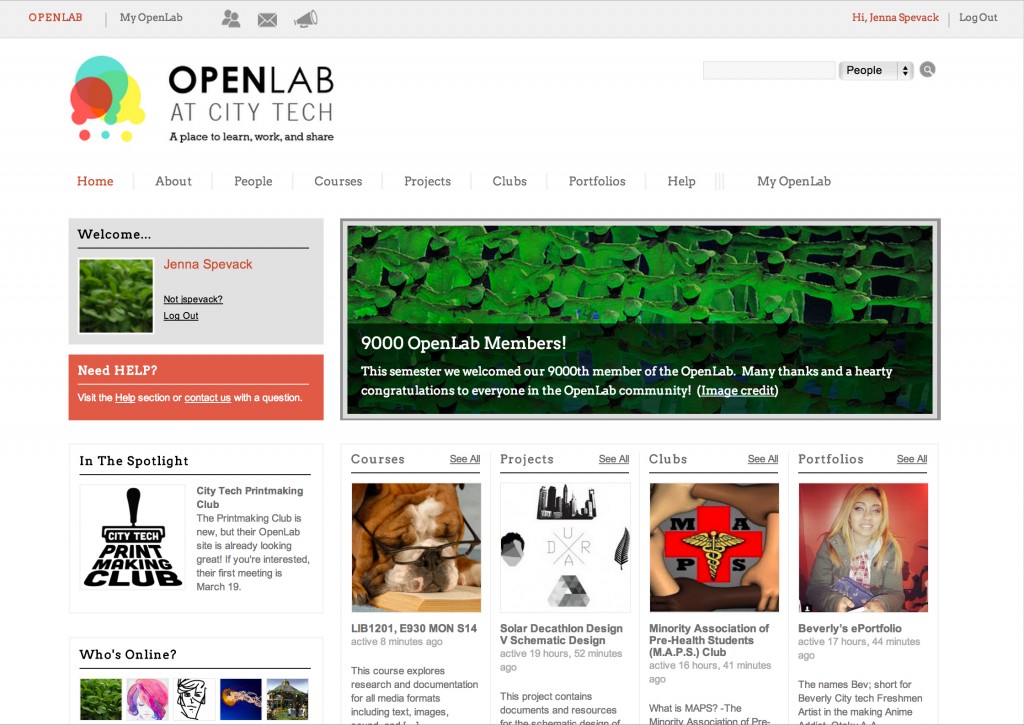
OpenLab_Homepage-1024x725Figure 1. OpenLab Home Page (click for full-size image)


A living lab

The OpenLab is a major component of “A Living Laboratory: Revitalizing General Education for a Twenty-First Century College of Technology,” a five-year project (2010-2015) funded by a grant from the U.S. Department of Education’s Title V Strengthening Hispanic-Serving Institutions program.[2] The Living Lab project aims to improve student engagement, specifically by addressing the difficulties that students encounter in making connections between their required General Education courses and the highly specialized coursework in their majors, even as these courses function as gateways to their fields. The project seeks to collaborate with groups throughout the college to re-envision General Education across the disciplines by using City Tech’s Brooklyn waterfront location as a living laboratory, employing place-based learning and the hands-on modes familiar to our students in their majors to increase student achievement, measured by grades and persistence, retention, and graduation rates.

The OpenLab was conceived as a key element of the Living Lab project that would both support the Living Lab’s goals and seek to address these larger institutional challenges of disconnection and fragmentation by strengthening the college’s social and intellectual fabric. As an open digital platform the OpenLab can make the college curriculum visible to City Tech students, and encourage them to make connections among their strengths, interests, and goals. The OpenLab creates avenues for community members in different classes, departments, and schools to connect with one another. It offers a virtual place for students, faculty, and staff to meet and work and an opportunity to strengthen the college community unfettered by the limitations of our physical plant. The OpenLab provides virtually through its online platform what the City Tech campus cannot always provide physically: a beautiful, inspiring space for communities to gather and grow.


Why Open? Why Lab?

The name OpenLab speaks to two important and pervasive themes of this initiative. Its open nature fosters community and connection. Unlike closed online systems such as Blackboard, the learning management system available throughout CUNY, the OpenLab allows members across the college to communicate with one another and the world outside City Tech. OpenLab membership is available to everyone at City Tech through a simple registration process. Members can see what other members are doing, as can visitors from outside of the City Tech community. Such openness has great potential. This open-by-default design provides greater transparency for students looking to see what goes on in other courses, offering them a unique insight into their choices for registration and choosing a focus or major. Faculty members can benefit from the innovative pedagogies their colleagues employ, and can see not merely which courses their students have enrolled in but also what they study in those classes. Staff members can get a glimpse into course activities that would not otherwise be accessible to them. For all members, the possibility of observing and participating in curricular, co-curricular, and extracurricular activity is an exciting prospect, one that is only possible because the system is open.

As a college of technology, City Tech uses throughout its curriculum a laboratory model that is both familiar to and successful for its students. The OpenLab fosters the kind of learning espoused in the City Tech mission statement, developing both intellectual curiosity and practical experience in career fields by creating active, hands-on, and process-oriented experiences. In so doing it pairs with the college’s educational goals for the students to apply problem-solving skills to their work in their professions and develop communication skills (New York City College of Technology n.d.a), fostering intellectual curiosity and practical experience in career fields. All members of the OpenLab—students, faculty, and staff alike—benefit from the opportunities for experimentation available to them through use of the tools it provides: blogging capabilities, collaborative documents, shared discussions, and the ability to integrate external tools easily and seamlessly. By using WordPress for content creation, OpenLab members gain valuable experience with software they will likely encounter again, whether for work or in their own extracurricular pursuits. We encourage students specifically—and all OpenLab members in general—to take advantage of the expertise they can develop in using WordPress, and to promote it as a skill when they move on from City Tech.

The OpenLab, in adopting the open source software WordPress and BuddyPress as its foundation, joins a worldwide laboratory of open source design and development. In creating the OpenLab, the team has been fortunate to build on the experiments and experiences of others at City Tech, CUNY, and beyond who have implemented WordPress and BuddyPress as open pedagogical tools over the past decade. The open digital platform that the OpenLab is most similar to is the CUNY Academic Commons, an academic social network launched in 2009 that connects faculty, staff, and graduate students across all 24 campuses of CUNY (the team has recently released the Commons In A Box, which puts a full-featured WordPress and BuddyPress implementation within reach for any institution). The OpenLab team also counts as inspiration UMW Blogs, built at the University of Mary Washington by Jim Groom and his team, and the University of British Columbia’s WordPress installation spearheaded by Brian Lamb. We have learned from WordPress projects at other CUNY colleges as well, including Baruch College’s Blogs@Baruch, Macaulay Honors College’s and York College’s student ePortfolio platforms, and Queens College’s undergraduate writing initiative. In building the OpenLab as a place for community at City Tech, then, we are proud to join a community of educators and technologists dedicated to opening education through the use of free and open source software and a commitment to open pedagogical practices.


The OpenLab in Theory

In addition to the strong lineage of inspiring open source projects that paved the way for the OpenLab, the project has theoretical grounding centered on the idea of student engagement as critical to ensuring that students are successful in their college careers (Kuh et al. 2007, xi). Certain pedagogical and social practices contribute to and bolster student engagement; these include frequent interaction between students and faculty, especially outside of class time, both academic and social interaction with peers, feedback received from faculty in a timely manner, and “time on task”—the amount of time students spend on their academic work (Kuh et al. 2007, 43). Further, a strong engagement with the college community may be especially important for commuter students such as those at City Tech, who spend less time on campus than do undergraduates at residential colleges (Krause 2007, 29).

Research also indicates that technological interventions like the OpenLab have the potential to strengthen student engagement at commuter institutions (Krause 2007, Kinzie et al. 2008). The OpenLab offers a platform for faculty-student and student-student interaction in courses and extracurricular activities, as well as multiple avenues for faculty and peer feedback on student work in a variety of media. Since the OpenLab is a web-based platform, the ability to accomplish coursework while off-campus may also increase the amount of time that students spend on their academic work. With the multiple responsibilities that our students navigate throughout their days in addition to their coursework, the opportunities for 24-hour, off-campus access to the OpenLab may be especially beneficial.

The OpenLab can also have an impact on student engagement beyond flexible access to coursework. Recent data collected for the National Survey of Student Engagement (NSSE), which samples over one million students at hundreds of four-year colleges and universities about their participation in programs and activities for learning and professional development, reveals that engagement rose among “[f]irst-year students who frequently used social media to interact with peers, learn about campus events and opportunities, and interact with faculty and advisors” (National Survey of Student Engagement 2012, 18). While the NSSE asked students about proprietary social media platforms, this finding corresponds with the observations of those working with open academic social networks. Matthew K. Gold, for example, notes that these platforms provide multiple pathways for connection via what he terms “low-stakes engagement”: “Students may visit the course site because they receive a friend request from a fellow student, and in visiting the site, they may quickly respond to a status update, contribute a link to a group, respond to a forum post, send a private message, or update their own status” (Gold 2011, 70-1). These academic social networks provide multiple avenues to attract students into a course, and in doing so can strengthen their ties to the college community.

The OpenLab can foster opportunities for our students to work and study together, to encourage each other, and to support each other’s success, which is far less likely when students do not know or feel connected to one another. Beyond this, though, as Gold and Otte report in their discussion of the CUNY Academic Commons, faculty and staff members too can similarly benefit from working with a platform that encourages collaboration, a networked structure that encourages interdisciplinary, intercollegial, and nonhierarchical conversations (2011, 10). Such a structure, however, does not come about automatically when WordPress is installed; rather, it is the result of conscious design choices made with community-building in mind.


Design of Place: Structure and Features

Customizing for community

The OpenLab and much of its user-created content is open and visible to the public, allowing prospective members and site visitors to browse and comment. Although only members of the City Tech community can join the site and actively create content, the site structure and home page content feed invite visitors to experience the dynamic learning environment and community that is not always visible on the physical campus.

BuddyPress, the open source social networking software integrated into the OpenLab’s WordPress Multisite installation, allows us to define a virtual place that supports City Tech’s community-building needs and provides the infrastructure necessary for an active, high-impact, connected learning environment. It offers social networking features like activity streams, member profiles, group and site creation, discussion, and collaborative document editing, and is at the core of sibling sites such as the CUNY Academic Commons. BuddyPress powers one of the most distinctive features of the Commons, its home page, which highlights recent activity by members, groups, and blogs, and gives visitors an instant snapshot of the vibrant Commons community. This integration of members and their activity, and the collaboration and cross-pollination it fosters, inspired the OpenLab’s home page design and organization.


OpenLab_Navigation-1024x725Figure 2. OpenLab “Group” configuration: Courses, Projects, Clubs, and Portfolios


There are, however, significant differences between the OpenLab and its sibling installations. The biggest modification, implemented in partnership with our consulting developers, was to customize BuddyPress and subdivide its default “Group” configuration into several discrete types, Courses, Projects, Clubs, and Portfolios:

  • Projects on the OpenLab can range from student research projects and collaborations to college committees to grant-funded academic journals, and can be created by individual or multiple members.
  • Clubs allow any member of the College community to grow an online space related to a particular social or academic interest.
  • Courses are set up to offer faculty members the tools to facilitate class collaborations, engage students in meaningful peer-to-peer learning, and provide a digital repository for course documents.
  • Portfolios are an extension of the College’s student ePortfolio initiative and allow for personal portfolio development for all OpenLab members, including faculty and staff. The member Portfolio is a WordPress or external site linked to the member Profile page. Members are encouraged to use the site to present their teaching, academic, or creative work.

These appear prominently in the navigation, along with People, the OpenLab’s directory of members. This organizational architecture supports usability and navigational aesthetics and facilitates group creation, interaction, and findability by separating groups into defined areas of focus that are familiar to our college community. This important customization helps to communicate a clear path for visitors and offers a foothold for members less experienced in open, collaborative systems.


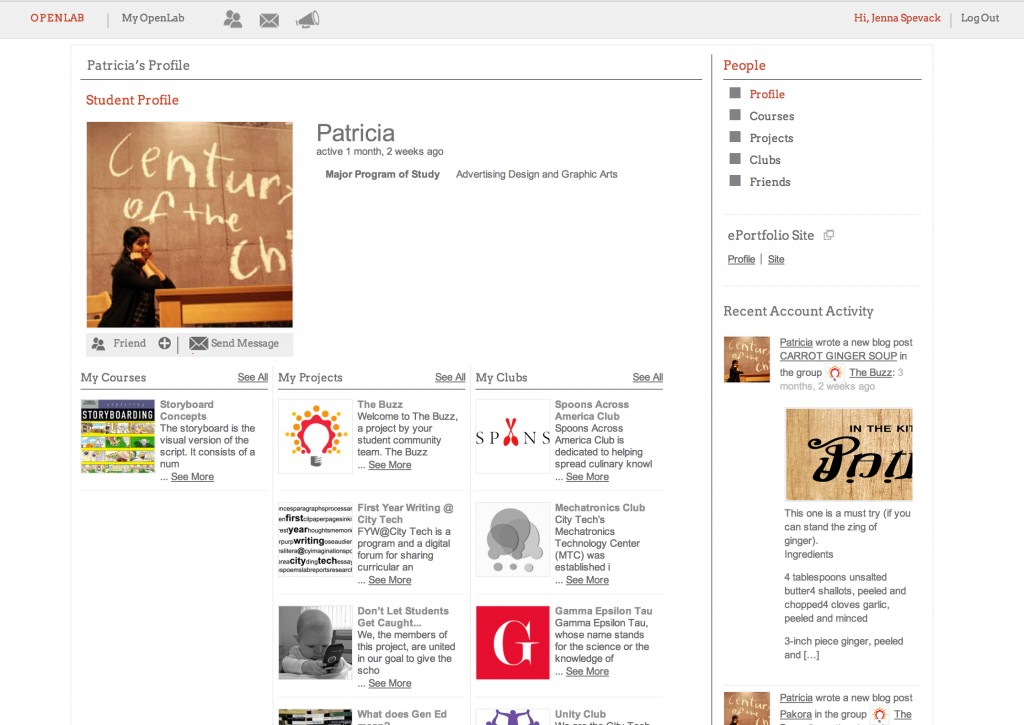
OpenLab_People-1024x725Figure 3. OpenLab People Page


The People section of the OpenLab brings together all our members—students, faculty, and staff—and provides access to their Profiles. Any member of the campus community with a City Tech email address may sign up and create a Profile on the OpenLab.[3] The member Profile presents the member’s academic interests, department or area of study, and contact information, as well as recent activity on the OpenLab including posts, comments, and discussion topics. Profile visitors can view the Projects, Clubs, and Courses that the member participates in, allowing them to make connections with others who have similar interests and providing opportunities to share learning, social, and research experiences with the greater OpenLab community. The member Profile also allows for a pseudonymous display name and allows the member to choose the information they share with others. Use of pseudonyms allows members to protect their identities without compromising the public nature of the OpenLab. We believe that giving members control over their self-presentation is an essential component of any open platform.


OpenLab_Profile-1024x725Figure 4. OpenLab Member Profile


The benefit of the OpenLab’s customized navigational sections is that it gives new or prospective members a place to start: browsing these general areas guides the member who might be interested in joining a campus club or seeing an example of a member Portfolio. Although not all groups on the OpenLab are public, those that are present the most recent data on the group Profile page. Although the OpenLab encourages openness, it also supports a range of fine-grained privacy options that enable groups to have public or private spaces as desired, and even a combination of the two. Each group Profile, similar to the member Profile, displays recent posts, discussions, collaborative document activity, group membership, and a link to the group’s associated WordPress site.


Listening to Campus Voices

The OpenLab team follows an iterative approach to design and development, the standard open source software methodology. After releasing a version of the site, we listen for feedback from members and observe how they embrace or ignore new features. Critical here is the work of the OpenLab’s Community Team.[4] All are advanced graduate students with expertise in both the technical and pedagogic aspects of using open source platforms in an educational context. Some of their work takes place behind the scenes: testing site updates, reporting bugs, evaluating and recommending plugins and themes, and developing the OpenLab’s Help content. They are also the friendly faces of the OpenLab, answering members’ questions via email and online, running workshops, visiting classrooms and offices, and maintaining open channels of communication between the OpenLab’s members and the rest of the team.

This community-minded method of development accepts the unpredictability of member needs and behaviors and allows the OpenLab to evolve as the community grows and develops. Following are several examples in which member requests and actions have translated directly into exciting new functionality and have greatly improved the design of the OpenLab as place to learn, work, and share.


My OpenLab

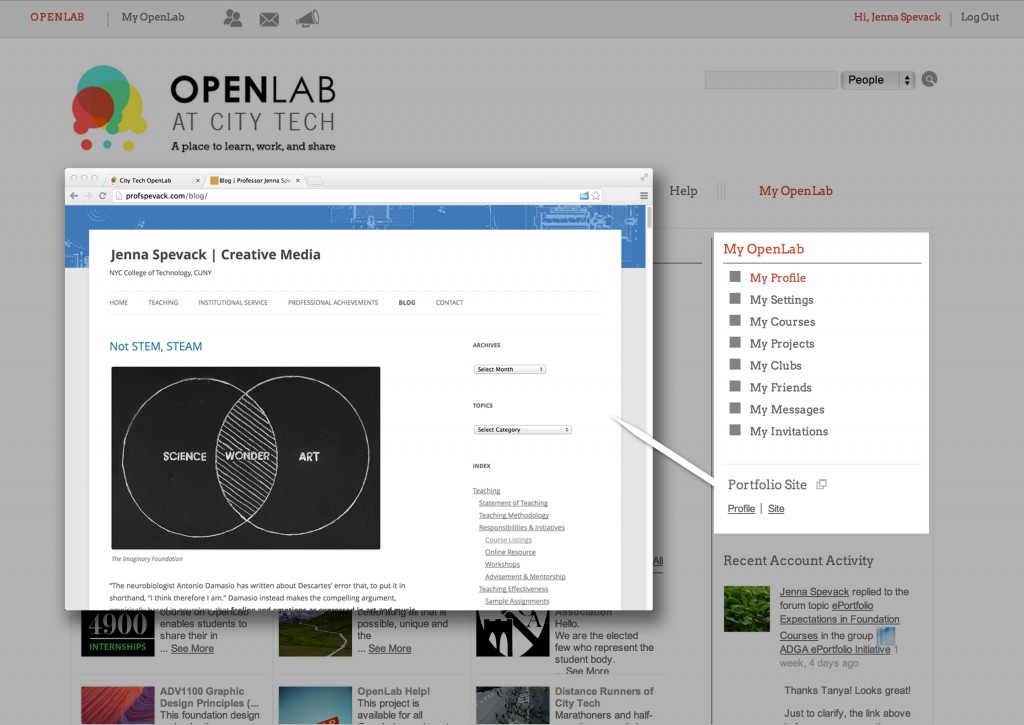
In the early releases of the OpenLab, its navigation and usability needed significant enhancement. Members repeatedly requested easier access to their personal settings and dashboards. A simple name, My OpenLab, was adopted for the member’s logged-in state, which was identified in headings and dropdown menus. My OpenLab makes the member’s content more readily available and improves overall usability, but also conveys a sense of place and ownership.


OpenLab_MOL_External_Portfolio-1024x725Figure 5. My OpenLab navigation, Portfolio integration, external site linking


External site linking

The ability to link a WordPress site to a group is available in BuddyPress, but this functionality did not extend to sites outside the OpenLab’s network. Many faculty members, some students, and a few campus clubs had however already developed web sites and were hesitant to start a site on the OpenLab if it meant recreating their sites there. Customizing the OpenLab’s BuddyPress install with the ability to link an external site to a group’s Profile now allows members with sites on other platforms to become part of the OpenLab community space, making this externally hosted content visible in activity feeds and on the home page. This seemingly small customization is actually a powerful intervention that simultaneously promotes member agency and inclusion. It allows the OpenLab to support those who are committed to maintaining a “domain of their own” (more formally, a “personal cyberinfrastructure,” Campbell 2009). We see this as particularly important for encouraging OpenLab participation among adjunct faculty, who may have their own independent teaching sites to accommodate their teaching on a number of campuses.


Cloning courses

As the number of courses on the OpenLab continued to grow, to over 600 current and past courses by the spring of 2014, it was clear that faculty needed tools to replicate their previous course structures, rather than starting from scratch. One key feature of the OpenLab is that course content remains available after the course ends; consequently, it was important to develop an alternative so faculty members would not empty courses for reuse by deleting past student data. This BuddyPress customization now offers faculty the opportunity to clone a course and establishes a best practice of maintaining an archive of past OpenLab courses available for student and department reference.


Portfolio integration

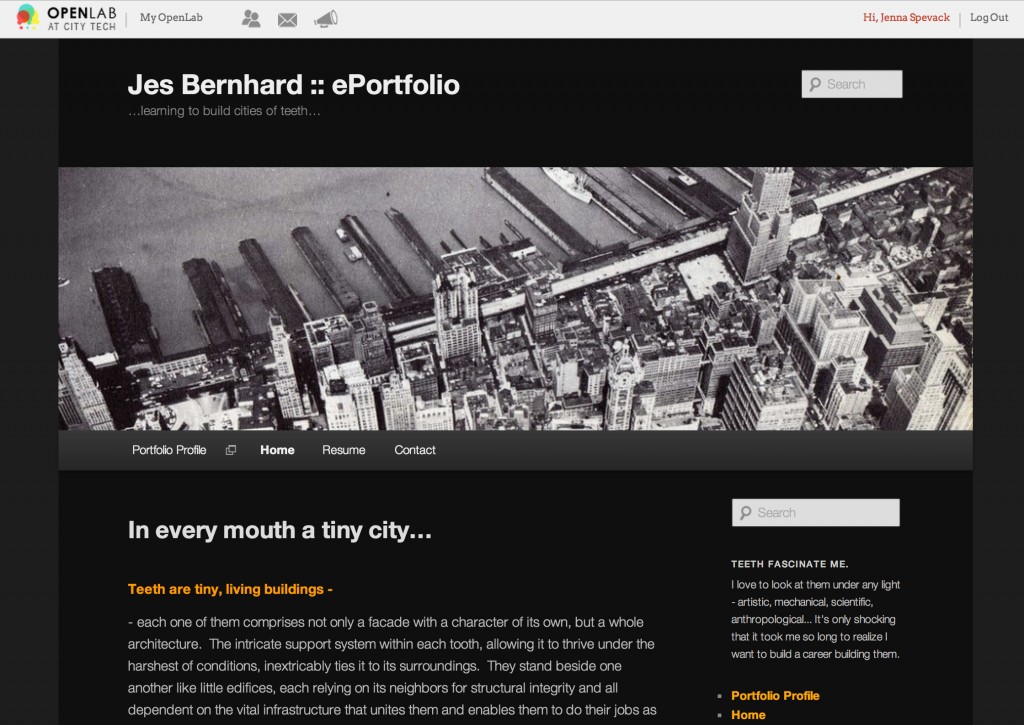
When the OpenLab was initially developed, the college was also looking for a new platform to host its student ePortfolios. The OpenLab was able to provide a home for this project, incorporating student ePortfolios into the site structure. A year later an initiative was launched to digitize faculty teaching portfolios and, once again, the OpenLab was the obvious place to turn. In response, we now offer all members of the college community the opportunity to create an online Portfolio, linked to the individual member’s Profile. Student ePortfolios, faculty teaching portfolios, and staff professional portfolios can now all be found together in the Portfolios section of the OpenLab. Through such design choices, the OpenLab becomes not only a solution to a logistical problem but a place for sharing, since students, faculty, and staff can see and learn from one another’s work.

These examples demonstrate our efforts to work toward a method of inclusionary innovation that encourages meaningful growth. We rely on member input to make the OpenLab the best it can be, with the aim of creating an inspiring, supportive gathering place that everyone at City Tech can share. The OpenLab’s designers strive to support this aim through compelling visual design that reflects well-considered information architecture and usability heuristics. Visitors and members alike regularly praise the OpenLab for its beautiful design. This is a tribute to the efforts not only of the current team but of the (now former) City Tech students who worked on the OpenLab’s original look and feel. Their design vision supports the hope that creating a beautiful place for learning, sharing, and belonging will foster community engagement and increase retention both within the OpenLab and at City Tech.


The OpenLab in Practice

Since the first semester of its use in beta, the OpenLab’s ambitious goals continue to be fulfilled in practice. The member-generated content of the OpenLab is a testament to the value of openness and of the laboratory model, and makes evident the OpenLab’s contribution to the college community. Examples of the benefits of the open, shared, democratic, and experimental avenues abound on the OpenLab.


Open

Charting new territory with a site on the OpenLab is a great opportunity for anyone interested in making content more visible. The OpenLab can offer a new and very real audience for that work because of its open nature. The openness of the platform encourages browsing through the shared materials, both in formal and informal ways—exemplified by a student who asked our Community Team why some courses were available for her to see whereas others required membership. She was following some of the courses in her major that she had not yet taken, or had taken with different professors, found reading these course sites a valuable resource, and began conversing with the faculty member to expand her education further.

Some courses assign what this student did voluntarily: to draw on the OpenLab’s openness as a source for learning. For example, a professor asked his Introduction to Poetry students to explore the OpenLab and to comment on materials on other courses’ sites. This not only challenged students to move beyond the comfort of their class’s community, but also reminded others that the OpenLab is open for this kind of cross-pollination. An English Composition professor asked students to examine other members’ avatars and report back about how they perceived members based on their avatars. This served the course as an introduction both to visual literacy and to the construction of an online persona. Another faculty member in Restorative Dentistry used the fact that the OpenLab is readily available to non-members by inviting colleagues from an international professional organization in the field of restorative dentistry to view his students’ work and comment on it. Here, students were exposed to an audience beyond the college, professionals with expertise to benefit their growth in the field.

Courses are not the only venues to benefit from being open. The needs of various college committees and organizations have been met by sharing information on the OpenLab. These additions have not been top-down, but rather reflect the community’s adoption of this much-needed place to collaborate. For instance, the college-wide Assessment Committee, in an effort to increase transparency and inform and involve more of the community, established an OpenLab Project that includes reports from the most recent assessment cycle for all participating departments. College Council has had a public site on a college server but is now developing its OpenLab presence. Committees that are open to all college faculty members might wonder what added value there could be in sharing their materials in the open forum of the OpenLab, rather than just with its voluntary members. In both of these examples, the openness of the site matters because the sites are part of the network, not hidden away from their potential audiences. Unlike stand-alone sites, the networked nature of OpenLab sites creates a broader audience for the work of these committees and organizations. Not only can faculty and staff members benefit from seeing what other committees are doing, but students as well can begin to see a clearer picture of the college, its infrastructure, and its concerns.


Shared

Community building is a central component of the OpenLab, creating venues for shared spaces in courses, among courses, and across the college. Learning Communities are a natural fit for the shared spaces of the OpenLab. These communities enroll a cohort of students in two or three courses that collaborate on a shared project or consider overlapping themes. In one of the first learning communities on the OpenLab, two professors in Hospitality Management and one in English connected their courses using the OpenLab via custom menus that seamlessly linked students from one course to the next. This connection fostered the sense that all three faculty members collaborated to create this more dynamic, more engaging experience for these first-year students. In another Learning Community, professors from Humanities and English similarly linked courses using custom menus in that first semester, and then subsequently began sharing their space in one Course site to facilitate their community’s joint project, a place-based endeavor that drew on semester-long projects that culminated in a virtual walking tour. This tour used various external technologies as it collated students’ on-site speech videos by embedding them in a shared Google map that was itself embedded on the shared OpenLab site.

The open nature of the platform can easily facilitate the development of unofficial learning communities. One instance came when two math professors joined efforts when each taught a section of the same course in the same time slot. They shared one OpenLab site for students to exchange reflections on their joint field trip, a walk across the Brooklyn Bridge to provide the basis for mathematical calculations, and even booked a larger classroom for one class session to accommodate both classes in a discussion of the results from their joint field trip. Other faculty members have experimented with unofficial learning communities, such as one bringing together a hybrid section with a fully online section of the same course. The opportunity to communicate and collaborate with other students is so important for the otherwise disconnected online students; pairing them with students who do have the chance to get to know each other face-to-face enhances the learning experience overall among the members of the created community.


Experimental

With the capability to expand educational opportunities through incorporating multimedia components into posts and pages, the OpenLab fosters the hands-on, active learning so many in our community strive to integrate into their courses. The availability of spaces to contribute content in a variety of media on the OpenLab can inspire disciplines not traditionally thought of as visual to make use of the site’s capability to incorporate images and videos, or those not typically considered writing-intensive to include expository blog-posts or collaborative-document assignments. In one math course on the OpenLab, students were asked to reflect on the term infinity both in its colloquial usage and as a mathematical term. To further support their understanding of these definitions, students were asked to relay a story about when they first learned about the term, and to incorporate a photograph that encapsulated the meaning. Writing, visual literacy, and a sense of play became vital skills to complete this math assignment, a great example of how the OpenLab creates a place for creative expression and innovative pedagogy.

In an Introduction to Hospitality Management course, students were asked to consider Brooklyn as the site of tourism. Imagining they were each the concierge in a boutique hotel in Brooklyn, students were asked to develop videos that guests would watch to pique their interest in a nearby location. Students could creatively cast their videos, considering not only the details of a location, but also the intended audience of the video and how they would want to represent the location to the clientele. This project took advantage of YouTube as a resource for storing videos that were then easily embedded into posts. It also identified for students their role and their audience, and offered a creative medium for students to consider the role of the concierge, and to experiment with place-based learning in a field-specific way.

In each of these examples, students had opportunities to use openly available digital tools and to transfer knowledge and skills from their college experience to work in their disciplines. Faculty members could continue to cover course content while expanding their pedagogical practices and affording students additional avenues for experimentation and creative expression. One student took on this challenge independently, conceiving of her ePortfolio not merely as a way to record her achievements in Restorative Dentistry but also as a customizable, thoughtful reflection of her approach to her field. Using the extended metaphor of a city to describe the mouth full of teeth, she showcased her dedication to her work and her interest in experimenting both in the lab and in her representation of that work.


OpenLab_ePortfolio-1024x725Figure 6. Student ePortfolio: Restorative Dentistry


Democratic

All members have the ability to create Projects, Clubs, and Portfolios—only faculty can create Courses, which is the only difference in permissions among the types of members—and to read or actively participate on public sites throughout the OpenLab. This means that in addition to officially sanctioned committees and clubs, there are numerous unofficial, unchartered, or even previously unformed groups coalescing in OpenLab Projects and Clubs. In a recent survey of OpenLab Clubs, the Community Team found that more were unchartered than officially City Tech-sanctioned, indicating that the OpenLab has given a place for students—and all members—to gather around common interests regardless of official support. Thus, in addition to the notable presence of the Student Government Association and the City Tech newspaper, there are also unchartered clubs such as Anime Gaming Underground, or the Mobile Application Developers. We are eager to provide support—both technical and community-building—for these ventures to become fully realized.

Projects such as the First Year Writing and Developmental Writing Resource Archive, which offer resources for faculty teaching the college’s sequence of composition courses and developmental writing, respectively, encourage full-time and adjunct faculty to join, share, and benefit from the wealth of resources that have been compiled. Providing opportunities for full-time and adjunct faculty members to share space and resources has been one of our main goals for the OpenLab, making it a space for all to get involved, regardless of rank or position. Many new projects are being developed to collate materials for faculty working on a given course or initiative, and to share discussion space to collaborate on the issues at the heart of that endeavor. These spaces open the conversation to adjunct faculty, creating avenues for their involvement that have not existed before. OpenLab workshops also create such shared spaces, since they provide support for faculty and staff, full-time and part-time alike, and can facilitate collaboration across and among departments and offices. As part of the Title V grant, adjunct faculty members receive a stipend to participate in OpenLab workshops; this further facilitates their inclusion in the OpenLab.


The OpenLab in Progress

These are just a few examples of the kind of work that the OpenLab enables; every day visitors to the site can find more. It has been exciting to see how the OpenLab’s members have grasped its potential for connection and collaboration, openness, sharing, and community-building. But of course technologies do not determine outcomes. Indeed, as Gold and Otte note in their discussion of the CUNY Academic Commons, any intervention in the mode and means of social interaction—and perhaps especially in education—is potentially disruptive and destabilizing (Gold and Otte 2010, 10). Inevitably, then, with all the OpenLab’s successes, there have been challenges along the way. Below are three of these and the approaches taken to address them.


Growing pains, growing community

The first challenge has actually been the OpenLab’s success: its dramatic rate of adoption. As the Living Lab’s external evaluator noted, the project’s original usage target (1,000 active members by the end of the grant) quickly looked “quaint.” Such vertiginous growth naturally brought technical concerns: with the site rapidly becoming essential to many of its members, we hardened its infrastructure for reliability and have recently optimized the database to ensure it can support this rate of growth for years to come. The biggest impact, though, has been experiential—a site with thousands of members simply feels different, and the individual members and the work they create can easily be lost in the sheer volume of activity and content. If we fail to attend to the affective dimension of site use, we could find ourselves simply replicating online the problems of disconnection and fragmentation that the OpenLab hopes to address.

Early in the development process, we made adjustments to the site design to showcase member content more effectively and make it more readily findable: the home page now shows the four most recently active groups of each type (Courses, Projects, Clubs, and Portfolios), and search and filtering capabilities have been added. Another important addition to the home page is the “In the Spotlight” section, which allows us to call attention to a different example of the exceptional work on the OpenLab each week. Members have reported their excitement at having their work recognized so prominently; when we featured the Restorative Dentistry student’s ePortfolio described above, its author responded that this appreciation of her work had not only provided encouragement but also “made it something real” for her, “something that a living person actually looked at and read (as opposed to an odd exercise similar to jotting things down, folding them into paper airplanes, and launching them into the cybervoid)” (Jes Bernhard, pers. comm.). We are planning other ways to celebrate member contributions and enable all members to participate in the selection process.

Evident in the above is the interplay between software and social. A social network should not be conflated with community;[5] building a sense of community among OpenLab members is an ongoing process that requires conscious and intentional individual and collective effort. The Community Team plays an important role here in helping members feel welcome on the site. With such a large member population, though, the Community Team cannot interact with everyone—members must create community by and for themselves. And they are. Many members complete public profiles and make “friend” connections. New faculty have set up a private space where they can share their experiences, ask questions, and discuss concerns. Faculty members continue to use the OpenLab to share ideas and resources, and discuss best practices with colleagues; adjunct faculty, who often find themselves marginalized at their institutions, are joining these conversations. Important student-facing administrative offices—Veterans Affairs, for instance—see the OpenLab’s potential for giving the students they serve a space of their own to communicate. Students have created initial presences on the site for key organizations and informal interest groups, too.

We believe, though, that there is more we can do to foster community on the site. We will be working to understand, through quantitative and qualitative approaches, how the OpenLab’s members (especially its less vocal members) use and experience the site, what works and does not work for them. We will be creating ways to bring members together on the OpenLab for shared activities—including, simply, fun.


A place for students

We are particularly interested in understanding the perspectives of one key group: students. Students make up the majority of OpenLab members (over 90% at this writing). However, despite the success of Courses on the OpenLab, the wide array of individual and group Projects created by students for their coursework, and strong adoption of student ePortfolios, we have yet to see widespread adoption of the site for extracurricular activities. There are many external factors that undoubtedly influence student use of the OpenLab. In addition to the time and space constraints we know affect City Tech students, another factor that may have an impact on their voluntary use of the OpenLab is access to technology. Although many own or have access to their own computers, tablets, or smartphones and Internet access from off-campus, others do not, and must rely on shared computers in their homes or at the college. As enrollment has risen, campus computer labs, like the campus overall, strain to accommodate the increasing number of students who wish to use them (Smale and Regalado, 2011). Thus, students may not always be able to access the OpenLab at a time and location that is convenient for them and conducive to using the OpenLab for extracurricular reasons. Additionally, while there are convincing arguments for using the OpenLab rather than closed, proprietary platforms, students may see Facebook or other social networks as more appropriate for co-curricular and extracurricular activities since they already socialize there.

We have no desire to construct a “creepy treehouse” to lure in students (see Gold 2011 for a discussion of this term [73-4]), but are concerned to help them understand that the OpenLab enables them to create places of their own, and that they can be co-creators of the OpenLab itself by participating in our collaborative development process. In response, we are making concerted efforts to engage City Tech’s students beyond the classroom. We have recently recruited a group of Student Community Team members who contribute regularly to a site they have named “The Buzz,” and are looking to expand the team to continue to provide dynamic content by and for our student population. Student team members have also begun working with our Community Team to conduct proactive outreach to student clubs and other organizations and provide them with help and guidance on incorporating the OpenLab into their activities. We hope that these efforts will encourage deeper integration of the OpenLab into student life at City Tech.


OpenLab_Buzz-1024x725Figure 7. Student Community Team Blog “The Buzz.”


Understanding the OpenLab

We are deeply committed to the OpenLab as a democratic space where students, full-time and adjunct faculty, and staff are equally welcome and valued, a space that they own and which is shaped by their needs, that encourages openness, connection, and experimentation while respecting its members’ privacy and their right to share, hide, create, or delete their work as they see fit. We have found, however, that conveying this vision requires continued work. Although many members have been with us for months or even years, each semester brings new students and faculty to City Tech and new members to the OpenLab. This means that, just as we explain the site’s features and functionality to new members, we must also seek to convey the aims and ethos of the project. Some members regard the site as another Blackboard or Facebook and complain that its features are lacking in comparison. We explain that their missions could not be more different—that Blackboard is a learning management system primarily focused on courses whereas the OpenLab is a space that anyone at City Tech can use (and that the platforms can readily co-exist). In regards to Facebook, we might observe that our efforts to build a social network at City Tech are ultimately aimed at improving student outcomes, not monetizing their data.

Members can certainly use the OpenLab without knowing or perhaps even endorsing its underlying argument. Accustomed to working with closed, rigid, and proprietary products over which they have little control, many people are not likely to expect educational and social media software to be open, flexible, and dedicated to enhancing their agency. We have learned, though, that the lack of a shared understanding of the project can limit its potential. For instance, if faculty members do not know the pedagogic benefits of the OpenLab’s open and collaborative features, they are less likely to use them; students will be reluctant to provide feedback if they have no expectation that their concerns will be heard and acted on; adjunct faculty may not join an open interest group if it is unclear that it is truly open to all.

Finding effective ways to build this shared understanding, then, is critical to our outreach activities. We have created a brainstorming game that faculty members can use to generate assignments that employ the affordances of open platforms such as the OpenLab to support specific learning objectives. This game has been used for City Tech professional development, and we have run interactive sessions at conferences to further promote open digital pedagogical practices. We are continuing to enhance the OpenLab’s Help content, and we have established an Open Pedagogy Project as a place to discuss and share best practice examples of OpenLab usage—explicitly articulating the project’s goals and guiding principles in spaces such as this allows us to hone them and debate them with the OpenLab’s members, and challenges us all to live up to them.


Sharing the OpenLab: at City Tech and with you

Each new semester allows us to revisit, revise, and improve. Not only our development approach but our entire project process is iterative, so the next few years promise to be as eventful as the last. We will continue to evolve the OpenLab in response to member feedback. A generative platform generates ideas; members are constantly coming up with new ways to use the site. One recent and exciting request is to provide support for alumni mentoring of current students. Additionally, the student team has come up with important suggestions that could help build community on the site, such as highlighting members with similar interests and mutual friends. Finally, like any active development project, we have a laundry list of improvements, large and small, that would benefit the OpenLab’s members.

Key for the project’s relationship with the college is the idea that members can work with the OpenLab, not just on the OpenLab. In other words, an open platform, built by and for City Tech, offers opportunities for collaboration, participation, and co-creation that are unthinkable with closed, proprietary software solutions. For example, the OpenLab creates rich possibilities for curricular integration across a wide range of disciplines. We have already developed an internship program in partnership with our consulting developers and City Tech’s Advertising Design and Graphic Arts department that has given students real-world experience in documenting and enhancing the OpenLab. We can imagine other synergies: students in City Tech’s new professional and technical writing major could create Help content that would be read by thousands of people; classes in web development could create plugins for the OpenLab and thus for the BuddyPress and WordPress communities; students in education fields could analyze and learn from best practices they find on the site. Thus, in addition to reaching out to student organizations, we are also working with academic and administrative departments, other grant-funded projects, committees, and so on, to help them explore what the OpenLab can mean for their work.

Looking beyond City Tech, we are also committed to sharing both what we have built and what we have learned along the way in creating, using, supporting, and sustaining the OpenLab. We have begun that process here, and welcome questions and comments. We have identified discrete items of OpenLab functionality that can be packaged as software plugins for release within the scope of the current grant funding. Our plans for future development include contributions that will benefit the wider WordPress and BuddyPress communities. Most excitingly, we are seeking to partner with others to make the OpenLab’s key features—such as, for instance, our customizations of BuddyPress group functionality—freely available to all.

The OpenLab has joined other dynamic initiatives in offering members opportunities for opening education. With the strength of this experience behind us, we close with a challenge. Free and open source software is proven, robust, and sustainable. A community of practice freely shares recommendations and advice, and the OpenLab team benefits from and seeks to give back to this growing and generous group. Every day the OpenLab provides a living demonstration of what students, faculty, and staff can achieve with an open platform that is built for community. Members across the college have seized the opportunities that the OpenLab provides to create open and shared spaces, to experiment and innovate, and have provided innumerable examples of the benefits of using and contributing to an open platform. We ask readers, and visitors to the OpenLab, to imagine what the use of open digital tools can do to strengthen their communities. The tools to open education are already at hand.


Acknowledgements

The authors would like to thank all members of the OpenLab team, present and past, for their contributions to the project. We are grateful to the OpenLab’s many supporters at City Tech, including all our colleagues in the Living Lab initiative. Finally, our deepest thanks go to the OpenLab’s members—without whom, of course, the site would be an empty shell. The OpenLab is enabled by “A Living Laboratory: Revitalizing General Education for a 21st-Century College of Technology” (2010-2015), a $3.1 million project funded by the U. S. Department of Education under its Strengthening Hispanic-Serving Institutions (HSI) Title V Program.

Bibliography

Campbell, Gardner. 2009. “A Personal Cyberinfrastructure.” EDUCAUSE Review 44 (5): 58-9. Accessed October 20, 2013, http://www.educause.edu/ero/article/personal-cyberinfrastructure. OCLC 42937303.

CUNY Office of Institutional Research. 2012. “2012 Student Experience Survey.” Accessed October 20, 2013, http://www.cuny.edu/about/administration/offices/ira/ir/surveys/student/SES2010FinalReport.pdf.

Gold, Matthew K. 2011. “Beyond Friending: BuddyPress and the Social, Networked, Open-Source Classroom.” In Learning Through Digital Media Experiments in Technology and Pedagogy, edited by R. Trebor Scholtz, 69–77. New York: Institute for Distributed Creativity. Accessed October 20, 2013, http://learningthroughdigitalmedia.net/beyond-friending-buddypress-and-the-social-networked-open-source-classroom.

Gold, Matthew, and George Otte. 2011. “The CUNY Academic Commons: Fostering Faculty Use of the Social Web.” On the Horizon 19 (1): 24–32. OCLC 39502849.

Gorges, Boone B. 2012. “Sowing the Seeds.” Teleogistic. Accessed October 20, 2013, http://teleogistic.net/2012/03/sowing-the-seeds/.

Kinzie, Jillian, Robert Gonyea, Rick Shoup, and George D. Kuh. 2008. “Promoting Persistence and Success of Underrepresented Students: Lessons for Teaching and Learning.” New Directions for Teaching and Learning (115): 21–38. OCLC 6541567.

Krause, Kerri-Lee D. 2007. “Social Involvement and Commuter Students: The First-Year Student Voice.” Journal of The First-Year Experience & Students in Transition 19 (1): 27–45. OCLC 40245359.

Kuh, George D., Jillian Kinzie, Jennifer A. Buckley, Brian K. Bridges, and John C. Hayek. 2007. Piecing Together the Student Success Puzzle: Research, Propositions, and Recommendations. ASHE Higher Education Report v. 32, no. 5. San Francisco: Jossey-Bass. OCLC 123013011.

National Survey of Student Engagement. 2012. “Promoting Student Learning and Institutional Improvement: Lessons from NSSE at 13”. Bloomington, IN: Indiana University Center for Postsecondary Research. Accessed October 20, 2013, http://nsse.iub.edu/html/annual_results.cfm.

New York City College of Technology. n.d.a. “About City Tech: Consumer Information.” Accessed October 20, 2013, http://www.citytech.cuny.edu/aboutus/consumer_info.shtml.

———. n.d.b. “About City Tech: Heritage & History.” Accessed October 20, 2013, http://www.citytech.cuny.edu/aboutus/heritage_history.shtml.

———. 2012. “Facts 2012-2013.” Accessed October 20, 2013, http://www.citytech.cuny.edu/files/aboutus/facts.pdf.

Smale, Maura A., and Mariana Regalado. 2011. “‘Sometimes I Type Papers on My Cell Phone:’ Mobile Digital Technologies and CUNY Students.” Paper presented at MobilityShifts: An International Future of Learning Summit, The New School, New York, New York, October 10-16. Accessed October 20, 2013, https://ushep.commons.gc.cuny.edu/results/.


[1]The OpenLab is the work of many hands, as will be evident here and the Credits page shows. The “we” used in this article thus seeks to represent not only the authors but the entire OpenLab team.

[2]The Living Lab includes three activities in addition to the creation of the OpenLab: conducting a faculty development seminar focused on using place-based learning and high-impact educational practices to infuse general education into courses; integrating the assessment of general education student learning outcomes across the curriculum; and building an endowment for the Brooklyn Waterfront Research Center. More information is available on the Living Lab project site.

[3]A valid City Tech email account is required to register with the site. Members retain access to their accounts during periods of inactivity and even after leaving City Tech; we believe members should have agency in controlling the content they have created on the site.

[4]Note that the Community Team concept is borrowed from the CUNY Academic Commons. We also benefit from the OpenLab’s other sibling installations in that our team members gained their experience by working with several of these initiatives. Additional support for students and ePortfolios is provided by the college’s Student Help Desk and ePortfolio teams.

[5] Boone Gorges, one of the lead developers of BuddyPress and a member of our team, has also made this observation (2012).


About the Authors

Charlie Edwards is Program Manager of the “Living Laboratory” initiative at NYC College of Technology, CUNY. After twenty years in commercial IT, she is now also a graduate student in the English PhD and Interactive Technology & Pedagogy Certificate programs at The Graduate Center, CUNY, with research interests in the Digital Humanities and Victorian popular fiction. She can be reached at [email protected].

Jody Rosen is an Assistant Professor of English and OpenLab Co-Director at NYC College of Technology, CUNY. Her research focuses on communication-intensive instructional practices in the classroom and in professional development, as well as representations of gender and sexuality in early twentieth century Anglo-American literature. She can be reached at [email protected].

Maura Smale is Associate Professor/Coordinator of Library Instruction and OpenLab Institutionalization Lead at NYC College of Technology, CUNY. Her research interests include undergraduate academic culture, game-based learning, open access publishing, and critical information literacy. She can be reached at [email protected].

Jenna Spevack is Associate Professor of Creative Media and OpenLab Co-Director at NYC College of Technology, CUNY. As an artist, designer, and educator, her projects and practices explore how interactions with and connections to ecological systems support resilience in the shifting natural-social-political landscapes. She can be reached at [email protected].

Can You Digg It?: Using Web Applications in Teaching the Research Process

Rochelle (Shelley) Rodrigo, Old Dominion University

Abstract

Instructors teaching research methods, especially undergraduate writing courses that focus on researched arguments, should use various web-based interactive applications, usually referred to as Web 2.0 technologies, throughout the research process. Using these technologies helps students learn various 21st Century technology and media literacies as well as promote diverse student learning methods and active learning pedagogies. The article provides examples of different type of web-based applications that might be used throughout the research process and then ends with a discussion of logistical concerns like student access and privacy rights.


Admit it, when you first search for something you use Google or check Wikipedia:

  • Of course!
  • What? Are you crazy! I can’t trust those sites.
  • I shout out to Facebook or Twitter.
  • Plead the fifth.

I don’t ask this question of my students; instead, I ask this question of my colleagues when I do workshops about teaching with technology (especially when teaching big end-of-semester term or research papers). Can you guess the results? If we admit that we are just as “guilty” of using Google or referring to Wikipedia and other online “friends” when seeking out information, isn’t it time we accept these as legitimate steps for research in the 21st century. Therefore, if going to the web is the one of the first steps for research, we should “digg” using various web applications when teaching research skills.

Digg is the catchy title for thinking about using web applications in research. On the one hand, I believe instructors do not use social bookmarking tools, like Digg, nearly enough while teaching basic research skills, especially in First Year Composition courses. However, I do not use Digg, nor ask my students to use Digg, because it has been repeatedly critiqued for the gender, age, and socioeconomic bias of the users who curate the materials (Lo 2006; Solis 2009; Weinberg 2006). Digg’s biased user population is representative of the promise and peril of the internet in general. If anyone can post on Digg, and I choose to use such a web application in my research, how does the bias of the application impact my research process and product. However, is that not the case with almost any research process and product we suggest for our students? In short, part of what we are teaching our students about research is to just be plain critical, of everything, including the tools we use (Selfe 1999).

Critical engagement with the technologies they use is a powerful motivator for having students work with various web applications. Learning how to use different technologies, learn new technologies and critically engage with technologies prepares students for staying successfully employed in the 21st century. The majority of lists citing the key skills needed to succeed in the 21st century include “information literacy” as well as “consume and compose multimedia.”(AT&T 2010; CWPA 2008; Partnership for 21st Century Skills n.d; NCTE 2008; Kamenetz 2010).

Lankshear and Knobel (2007) claim that:

The more a literacy practice that is mediated by digital encoding privileges participation over publishing, distributed expertise over centralized expertise, collective intelligence over individual possessive intelligence, collaboration over individuated authorship, dispersion over scarcity, sharing over ownership, experimentation over ‘normalization’, innovation and evolution over stability and fixity, creative innovative rule breaking over generic purity and policing, relationship over information broadcast, do-it-yourself creative production over professional service delivery, and so on, the more sense we think it makes to regard it as a new literacy. (228)

If the Web 2.0 world is promoting these types of changes, researching in the Web 2.0 world might need to be considered a new literacy.

This article argues that instructors teaching research methods, especially undergraduate writing courses that focus on researched arguments, should use various web-based interactive applications. The article discusses how these applications, usually referred to as Web 2.0 technologies, are a way to meet 21st Century Literacies learning objectives as well as diversify student learning methods and facilitate active learning pedagogies. The article then provides examples of different types of web-based applications that might be used throughout the research process, and ends with a discussion of logistical concerns like student access and privacy rights.

Why Digg It?

Once you get out into the real world you won’t have your textbooks with you, so having experience using IT as a learning tool helps prepare people for life after textbooks.
–An undergraduate student, 2010 ECAR Study of Undergraduate Students and Information Technology (Smith and Caruso 2010, 27)

The obvious first reason for teaching students to use web applications in research is “if you can’t beat them, join them.” I know students are going to use Google; therefore, I embrace that default and enjoy introducing them to specialized Google search engines like Google Scholar (Google’s search engine that focuses on returning results from scholarly books and journals), Google Books (Google’s search engine that returns results from Google’s book scanning project), and Google News (Google’s search engine that returns results from news outlets as far back as the 19th century). I enjoy their “shock” in learning about these specialized search engines.

Since 2004, college students responding to the annual ECAR Study of Undergraduate Students and Information Technology have rated themselves highly for the ability to “use the Internet effectively and efficiently search for information” (Smith and Caruso 2010, 66). Specifically in 2010, 80.7% gave themselves “high marks (expert or very skilled)” and over 56% gave themselves high marks for “evaluating reliability and credibility” (69). However, if students are as information literate as they think, then why does it feel like there is a “crisis” of 21st Century Literacies? Although it feels like the “crisis” of 21st Century Literacies is restricted to the 21st century, the heart of this crisis is wrapped up in various techno-literacies and the various media or techno-literacy crises have been rampant for over 40 years. Since the National Council of Teacher’s of English (NCTE) published the “Resolution on Media Literacy” in 1970, it has followed up with a variety of other related lists and position statements about techno-, media, and 21st century literacies.

Many other educational organizations produce lists and policy statements that include things like:

  • using technology to gather, analyze, and synthesize information (ASCD 2008; Association of Colleges and Research Libraries 2000; Council of Writing Program Administrators [CWPA] 2008; National Council of Teachers of English [NCTE] 2008; & Partnership for 21st Century Skills n.d.) as well as
  • describe, explain, and persuade with technology (Conference on College Composition and Communication 2004; CWPA 2008; Intel n.d.; NCTE 2005; NCTE 2008; & Partnership for 21st Century Skills n.d.).

Forbes’s top 10 list of “skills that will get you hired in 2013” listed “computers and electronics” as number five; the top two skills listed were “critical thinking” and “complex problem solving” (Casserly 2012)—both required of major research and writing projects. Teaching research processes through and with web 2.0 technologies combines these skills. In a study of basic writing students, Vance (2012) found that although students do want the interactivity that comes with Web 2.0 technologies, they also want more stable, instructor vetted and delivered content as well. This desire hints at the fact students do want and need help identifying and using digital information. Instructors are being hailed by both (the overestimation of) their students as well as (the underestimation of) their colleagues to help students become better technologically-mediated researchers and communicators.

Getting students to understand that there is more to Googling than just Google not only helps develop more critical digital research skills, it builds upon what they already know and do. Most individuals do some form of research every day, and more often than not, Google does get the job done. Starting with what the students already do works not only because we are going with the flow; actually, it is because it is going with their flow. Brain research demonstrates that students learn best when what they learn is connected to something they already know or do (Leamnson 1999; Zull 2002). The process of teaching research skills needs to be built upon students’ existing processes. Instead of trying to completely rewire students–as science instructors often attempt to do when they continually repeat that seasons are based on the position of the earth’s axis and not its proximity to the sun–help them adapt and expand their already hardwired “Google it” response. A number of scholars have published that various Web 2.0 applications support research-related activities like reading (Won Park 2013) and finding and evaluating information (Magnuson 2013), and are compatible with learning pedagogies such as constructivism (Paily 2013), connectivism (Del Moral, Cernea, and Villalusttre 2013), and problem-based learning (Tambouris et al. 2012).

Increasingly, both scholarly as well as more plebian research resources are only available in digital formats, usually accessible through the web. Students not only need to learn how to (systematically) search for these resources, they need to learn to critically consume different types of resources, some with no written words. Once students find and read these resources, they also need help collecting, archiving, and analyzing them as well. Finally, with the variety of available digital publication media, students can contribute back by producing multimedia projects as they report out on their research process and product.

What are You Digging With?

Scholarship in composition and literacy studies has demonstrated as a field composition studies supports using web-based interactive communication applications, many referred to as Web 2.0 technologies, in the teaching and learning of writing. Strickland (2009) claims “writers should be able to use all available technology to help them discover what and how to say what needs to be written” (p. 12). Many of these web-based applications either “count” as the multimodal compositions that scholars like Takayoshi and Selfe (2007) as well as organizations like NCTE (2005) and CCCC (2004) promote or help produce those same multimedia texts. Even English education programs, like the one discussed in Doering, Beach and O’Brien (2007) promote teaching future English teachers about using different web-based applications. Most of the time, however, these discussions about using various web-based technologies are focused on the product of a student’s major research project. Many of these technologies can also support the writing process as well as the research process. The mistake that many instructors make in thinking about incorporating multimedia and web applications in the research process is only focusing on the products of research—the primary, secondary, or tertiary resources incorporated into research or the “report” out of the research. Successful 21st century researchers need to think about using various web applications and embracing multimedia throughout the entire research process:

  • Identifying a Topic
  • Finding & Collecting Resources
  • Critically Reading & Evaluating Resources
  • Synthesizing Ideas & Resources
  • Drafting & (Peer) Reviewing
  • Presenting Final Results

For example, instructors may only think that YouTube (a video repository where individuals can make accounts and upload videos to share) is only good for finding questionable resources and presenting final projects in video form. However watching videos on YouTube, Vimeo, or TED might help students struggling to find a topic that interests them or see how people are currently talking about a specific topic. It is definitely time to rethink “YouTube is a bad resource” just because anyone can post a video; will anyone question the scholarly veracity of one of Michael Wesch’s digital anthropology videos? YouTube can also help solve common formatting problems as well. Instead of using time in class showing students how to do headers and hanging indents in their final research papers; assign as homework a YouTube video demonstrating how to do the formatting functions in different version of MS Word or OpenOffice.

Ultimately the goal for this article is to outline examples of what types of web applications might be incorporated at various points within a traditional (primarily secondary) research process. First, getting students to produce and share texts through the research process helps them keep connected with an audience. Second, producing digitized final projects that are published to the web, especially multimedia projects, makes students’ work refrigerator door worthy; you know, like the finger paintings we brought home from preschool. And Facebook is the new refrigerator door, instantly giving students a real audience with real feedback that they care about.

Applications to Help Identify a Topic

Getting students started on a research project is always more difficult than expected. At the beginning of a research project students generally need to identify a topic that is engaging to them as well as narrow it down to something unique. In both cases, students need help thinking differently about their interests. As Brooke (2009) suggests, researchers should understand search results as “departure points, that bring potentially distant topics and ideas in proximity both with each other and the user” (83). Sometimes it just helps to provide them with a variety of alternative search engines (anything besides the general Google search engine) and media repositories (image, audio, video, and text) to help identify what interests them. Many students do not pay attention to the variety of ways they may filter search results in the left hand menu of a Google search results page nor know that Google has specialized search engines like Scholar, Books, and News. Although the web is full of personal rants and raves, those non-scholarly resources, like personal blogs and wikis (including Wikipedia), can be extremely useful in helping students further narrow a topic to something manageable and with a unique angle as well as analyze what they already know or believe about the topic. Using search engines that present the search results visually (for example: Cluuz, Hashtagify, Search-Cube, or TouchGraph) can also help with narrowing a topic as well as preparing a list of future search terms (figure 1).

rodrigo

Figure 1: Results from a Cluuz search; multiple visual cluster maps presented on the right side of the page.

In short, the varied web resources provide students the opportunities to both explore as well as narrow their research topics. Introducing students to advanced search pages or results filters will not only help them identity interesting, focused research topics, it will help them find relevant secondary resources as well.

Applications to Help Find & Collect Resources

Teaching students to find resources is generally easier than helping students collect the resources they find. Based on my experience, robust citation management applications like Zotero, Mendeley, or EndNote have a steep learning curve for users to understand both the citation management as well as note taking functionalities. The time to learn the various aspects of the applications usually requires more time than available in freshman and sophomore level classes with major research projects. Instead of using these more complex applications, students can use social bookmarking sites, like Delicious and Diigo (usually easier to learn than full resource collecting programs), to keep track of their resources. Social bookmarking sites collect users saved webpage URLs. Except, instead of being restricted to one computer, like when saved using My Favorites in the Internet Explorer browser, social bookmarking sites save the list of links to a server the user can access from any computer connected to the web. Most social bookmarking sites also allow the user to associate notes with each bookmarked webpage.

Even if students are collecting books they found at the library or journal articles they found in a library database (resources that are not normally associated with a webpage), they can bookmark WorldCat’s or the library’s webpage representing the book (figure 2) and link to the permalink, or deeplink, into a library database resource. Johnson (2009) explicitly argues that using different Web 2.0 technologies, like blogs and social bookmarking, allow students to more readily collect both their secondary as well as primary resources. The amount of detail included with the bookmarked resource is only limited to the assignment requirements given to a student. An instructor can ask a student to include information like a bibliographic citation, summary, and source evaluation in the “notes” area of the social bookmark for each resource (figure 2).

Rodrigo2

Figure 2: An example of a robust annotated bibliography entry in the social bookmarking application Diigo.

Since they are social, social bookmarking sites are by default public and make it easy for students to share resources with one another, or their instructors. Social bookmarking sites will also help students find more resources. They can find individuals who have bookmarked the same resources and identify other resources. Students can also identify how individuals tagged resources with identifying keywords, like indexing, and use those tags as alternative key words in more searches in databases and other locations. As web-based applications, social bookmarking sites also address some access issues; students who do not have regular access to the same computer can still store all of their collected resources in one online repository that they can get to from any computer with an Internet connection.

Applications to Help Critically Read & Evaluate Resources

More sophisticated social bookmarking tools like Diigo also allow students to read and annotate web resources (applications like A.nnotate and Internote also allow web page annotations). Diigo allows users to highlight and leave post-it styles notes on most webpages (figure 3).

Rodrigo3Figure 3: Example of Diigo highlight and “post-it” note style annotation tools.

Having the ability to take notes does not inherently prompt students to be critical readers, instead a functionality that enables commenting might prompt students to ask what type of questions and comments should the annotated on their resources. English faculty, or librarians, can provide students with a list of resource evaluation questions that students might then answer by highlighting and taking notes on the page. Since Diigo is a web application, students can share their annotated resource with other students or the instructor.

Applications to Help Synthesize Ideas & Resources

Once students’ notes are digital, it is easy for them to slide them around, looking for connections to help synthesize ideas and resources. Again, these web applications do not inherently make students engage their resource materials in more sophisticated ways; instead, these resources provide students with the opportunity to engage with and connect their resources differently. Writing instructors have asked students to make mind or cluster maps of their research topic, resources, and ideas for decades; however, having students make these in a web application allows for more detailed information associated with each node. Many of the digital mind map applications (like Mindomo and Popplet) allow users to include text, images, videos, even attachments to each individual node of information. Many mind map applications also allow users to collaborate, sometime even synchronously, within the same document. A team of students working on a research project could collaboratively construct a mind map with the different resources each individual located. Timeline and geographical mapping applications, web applications that allow users to map information as a point in time or geo-spatially, also allow students to interact with their resources and data in different ways (figure 4).

Rodrigo4

Figure 4: Example of a timeline showing various organizational statements about 21st Century Literacies.

Having students play with their resources and data forces them to spend time with their resources and data. Ultimately, it is that time with the data that helps students the most in synthesizing information in a meaningful way.

Applications to Help Draft & (Peer) Review

Students should be drafting and getting feedback along the entire research process. One of the standard functions of various Web 2.0 applications, also regularly referred to as read/write web, is some form of interaction between the many kinds of readers and writers (Dilager 2010). Even as early in the process as identifying and narrowing a topic, students should be able to share their narrowed topic or research question and possibly make a research plan. In either case, students will want feedback about their work. Microblogs, like Twitter and the Facebook Status Update, give students the opportunity to gather quick feedback on material as small as a research question or thesis statement.

There are a variety of read/write web applications students might use to report out and invite feedback of all amounts during their research projects. Blogs, wikis, and document sharing applications like Google Drive would allow students to document large portions of their research process and product. These popular applications are also probably the best known and most written about web applications to support the teaching of writing, especially as a way to expand audience feedback and participation with a given project (Alexander 2008; Johnson 2009; Nakamura 2011). Blogs, wikis and document sharing are usually structured to facilitate some form of a social network that invites “replies” to any posted work. Some advanced feedback applications allow readers to respond to specific sections of a draft. For example, the CommentPress Core plugin for a WordPress blog allows readers to comment on individual paragraphs as well as an entire posting. Similarly, VoiceThread allows viewers to comment on individual presentation slides as well as draw on an individual slide to reference a specific area of a visual.

Not just text based web applications facilitate replies to content; even the more visual Web 2.0 applications where students might post parts of their research usually include spaces for readers to make comments. Most image and video repositories usually have reply features. Even if students are publishing their work in progress or request for feedback in different locations, using microblogs can help them to send out requests for feedback with links to where ever the material is residing. In short, there is no technological reason not to request and receive feedback throughout the entire research process.

Applications to Help Present Final Results

Many of the applications mentioned above might also be used as final presentation formats or media. Document sharing would allow for easy publishing of traditional paper style presentations. And if students were blogging their entire research process, they can post their final presentation as the last post (however, the first visible to visitors) on their research blogs. Students might use alternative visual presentations applications like Prezi to distinguish themselves from the masses that use PowerPoint. However, there are a many Web 2.0 applications not discussed in this article that would allow students to get really creative with their final product. With all the freely available web 2.0 applications mentioned in this article or listed at websites like Go2Web20 and Discovery’s Web 2.0 Tools, students could produce a variety of media including audio or video files, timelines or maps, digital collages or mind maps.

Asking students to produce their final presentations in these alternative formats does not necessarily relieve them of the rhetorical responsibilities of a composition class (Takayoshi and Selfe 2007). Asking students to write cover memo identifying their purpose, audience, and other rhetorical factors as well as discussing how their project meets those rhetorical factors reengages students with their rhetorical responsibilities.

How to Digg It?

Beyond thinking about how to use the technologies, many instructors have two major concerns about incorporating any technology into their assignments: access and support. Although these are both legitimate concerns, the digital divide is alive and well in the second decade of the 21st century (Jansen 2010), the need to creatively overcome these concerns meets the objective of making our students more technologically savvy. In other words, most individuals face some form of technological access and support issue on any digital project. Putting students into groups for assignments, even if they are just support and peer review groups for research projects, resolves a lot of access and support issues. Constructing student groups as collaborative learning communities empowers them to share knowledge and resources, including “access” to specific types of needed hardware and software and the skills to use it. Having students understand that finding and learning how to use a specific technological application is both another example of research as well as a skill they will need to continue to hone with how fast both hardware and software updates and evolves. If a given Web 2.0 application’s help page is not helpful, and the group can’t figure it out how to use the program, YouTube is always a good place to look for help with any “how-to” question. And if there is still no answer on YouTube, maybe it is time for instructors to make a few “how-to” videos and post them up to YouTube.

Another concern that faculty, administrators, and scholars have about using web applications in classes is privacy, especially in relation to legal issues like the Family Educational Rights and Privacy Act, FERPA (Diaz 2010; Ellison and Wu 2008; Rodriguez 2011). Although many of the web applications I discuss above have privacy options, more conservative interpretations of FERPA argue that students rights are not protected since the school does not have an officially signed legal contract with the application provider. There is no one easy solution to the FERPA issue; however, honesty is the best policy. I have discussed using these types of applications with the legal personnel associated with my institution. With their help, I’ve added a section to my syllabus about using web applications (Appendix). In short, this section notifies students of their legal rights to privacy and legal responsibilities like copyright infringement; it also provides them an alternative option that is not posted to the Internet. Of course, the alternative option is the traditional research process and paper; however, to date, I have never had a student take the alternative option. I have had an increasing number, still a very small number, choose to password protect their work; however, no one has refused to use the web application.

Long-term access and archiving are final concerns with using web applications for academic assignments. It is true that individuals or companies maintaining different web applications go out of business and can no longer support the website. For example, I once had a student construct a beautifully researched and documented timeline and then the company supporting the timeline application stop supporting the service. Similarly, I’ve had classes of students develop mind maps in mindmeister for free before mindmeister canceled their free accounts; those mind maps are now inaccessible (unless the student pays for them). Again, instead of using this as an excuse, it can be a “learning moment” to have discussions with students about archiving their work in an alternative format. At minimum, it is relatively easy to either take static or dynamic screen captures to save images or video of student work. Consider having students use free screen capture software, like Jing or Screencast-O-matic, to report out and reflect upon their work as a part of their assignment. The could make a five minute video, or two, that introduces the project, discusses their rhetorical choices, and reflects upon the process of constructing the text. This reflective screen capture video assignment does double-duty in archiving their work in an alternative format.

Interestingly enough, many educational institutions or educational technology companies have tried to address issue like FERPA and archiving by developing their own versions of Web 2.0 applications, like Purdue University’s relatively successful Hotseat and Blackboard’s incorporation of blogs, wikis, and social media like interfaces into their learning management system software. However, I agree with Jenkins (2008) and Dilager (2010) that replicating services is generally not a good idea. Most homegrown technologies never work as well as the “original” and other institutional issues about continued command, control, and support emerge. Instead, Dilager argues for a “critical engagement with Web 2.0” (24), implying that both faculty and students should consider the original purpose and authors/companies producing the Web 2.0 applications they are using. For example, Facebook is a service for profile application (the service is free because the application mines profile information and sells it to other companies). Faculty should understand Facebook’s commercial element before requiring students to use the application. This type of critical engagement brings us full circle to the issue of user/curator bias in Digg, just as with evaluating research resources, faculty and students should evaluate the technologies they choose to use.

Although there are a variety of reasons that might make it difficult to incorporate different interactive web-based, Web 2.0, applications into undergraduate research courses, the benefit of having more engaged students as well as more critical and complex researched projects is worth the work. Providing students with a scaffolded project that asks them to engage with these different technologies helps prepare them for the variety of research processes they will undertake in their future academic, professional, and civic lives.

Bibliography

Alexander, Bryan. 2008. “Web 2.0 and Emergent Multiliteracies.” Theory Into Practice 47(2): 150-160. OCLC 424874670.

ASCD. 2008. “21st Century Skills.” ASCD. Accessed September 5, 2013. http://www.ascd.org/research-a-topic/21st-century-skills-resources.aspx.

Association of Colleges and Research Libraries. 2000. “Information Literacy Competency Standards for Higher Education.” Association of Colleges and Research Libraries. Accessed September 5, 2013. http://www.ala.org/acrl/standards/informationliteracycompetency.

AT&T. 2010. “21st century literacies: http://www.kn.pacbell.com/wired/21stcent/.” Internet Archive Wayback Machine. Accessed May 31, 2013. http://web.archive.org/web/20110716160908/http://www.kn.pacbell.com/wired/21stcent/

Brooke, Collin Gifford. 2009. Lingua Fracta: Toward a Rhetoric of New Media. Cresskill, NJ: Hampton Press. OCLC 366469179.

Casserly, Meghan. 2012. “The 10 Skills That Will Get You Hired in 2013.” Forbes, December 10. http://www.forbes.com/sites/meghancasserly/2012/12/10/the-10-skills-that-will-get-you-a-job-in-2013/.

Conference on College Composition and Communication. 2004. “CCCC Position Statement on Teaching, Learning, and Assessing Writing in Digital Environments.” National Council of Teachers of English. Accessed June 1, 2013. http://www.ncte.org/cccc/resources/positions/digitalenvironments.

Council of Writing Program Administrators. 2008. “WPA Outcomes Statement for First Year Composition.” Council of Writing Program Administrators. Accessed June 1, 2013. http://wpacouncil.org/positions/outcomes.html.

Del Moral, M. Esther, Ana Cernea, and Lourdes Villalustre. 2013. “Connectivist Learning Objects and Learning Styles.” Interdisciplinary Journal of E-Learning and Learning Objects 9: 105–124. http://www.ijello.org/Volume9/IJELLOv9p105-124Moral0830.pdf.

Diaz, Veronica. 2010. “Web 2.0 and Emerging Technologies in Online Learning.” New Directions for Community Colleges 150: 57-66. OCLC 650836072.

Dilager, Bradley. 2010. “Beyond Star Flashes: The Elements of Web 2.0 Style.” Computers and Composition 27(1): 15-26. OCLC 535530420.

Doering, Aaron, Richard Beach, and David O’Brien. 2007. “Infusing Multimodal Tools and Digital Literacies into an English Education Program.” English Education 40(1): 41-60. OCLC 424828004.

Ellison, Nicole B., and Yuehua Wu. 2008. “Blogging in the Classroom: A Preliminary Exploration of Student Attitudes and Impact on Comprehension.” Journal of Educational Multimedia 17(1): 99-122. OCLC 425163509.

Intel. n.d. “Technology Literacy.” Intel. Accessed September 5, 2013. http://www.intel.com/content/www/us/en/education/k12/technology-literacy.html.

Jansen, Jim. 2010. Use of the Internet in Higher-income Households. Pew Internet. Accessed June 1, 2013. http://www.pewinternet.org/Reports/2010/Better-off-households.aspx.

Jenkins, Henry. 2008. “Why Universities Shouldn’t Create ‘something like YouTube’ (Part One).” Confessions of an Aca-Fan (blog). Accessed June 1, 2013. http://henryjenkins.org/2008/10/why_universities_shouldnt_crea.html.

Johnson, Mary J. 2009. “Primary Sources and Web 2.0: Unlikely Match or Made for Each Other?” Library Media Connection, 27(4): 28-30. OCLC 425516321.

Kamenetz, Anya. 2010. DIY U: Edupunks, Edupreneurs, and the Coming Transformation of Higher Education. White River Junction, VT: Chelsea Green Publishing Company. OCLC 449895015.

Lankshear, Colin, and Michele Knobel. 2007. “Researching New Literacies: Web 2.0 Practices and Insider Perspectives.” E-Learning 4(3): 224-240. OCLC 593828824.

Leamnson, Robert. 1999. Thinking about Teaching and Learning: Developing Habits of Learning with First Year College and University Students. Sterling, VA: Stylus. OCLS 39671176.

Lester, Jim D, and James D. Lester. 2012. Writing Research Papers 14th edition, New York: Pearson. OCLS 746477415.

Lo, Ken. 2006. “Digg political bias.” Ken’s Tech Tips: Helping you to get the most out of Modern Technology and Communications since 2004 (blog). Accessed June 1, 2013. http://cow.neondragon.net/index.php/1607-Digg-Political-Bias.

Magnuson, Marta L. 2013. “Web 2.0 and Information Literacy Instruction: Aligning Technology with ACRL Standards.” The Journal of Academic Librarianship 39 (3) (May): 244–251. OCLC 4950915526.

Miller-Cochran, Susan K., and Rochelle L. Rodrigo. 2014. The Wadsworth Guide to Research 2nd edition, Boston: Wadsworth. OCLC 847942780.

Nakamura, Sarah. 2011. “Making (and not making) Connections with Web 2.0 Technologies in the ESL Classroom.” TETYC 38(4): 377-390. http://www.ncte.org/journals/tetyc/issues/v38-4.

National Council of Teachers of English. 2013. “21st Century Literacies.” National Council of Teachers of English. Accessed September 5, 2013. http://www.ncte.org/positions/21stcenturyliteracy.

National Council of Teachers of English. 2005. “Position Statement on Multimodal Literacies.” National Council of Teachers of English. Accessed June 1, 2013. http://www.ncte.org/positions/statements/multimodalliteracies.

National Council of Teachers of English. 1970. “Resolution on Media Literacy.” National Council of Teachers of English. Accessed September 5, 2013. http://www.ncte.org/positions/statements/medialiteracy.

National Council of Teachers of English. 2008. “The NCTE Definition of 21st Century Literacies.” National Council of Teachers of English. Accessed June 1, 2013. http://www.ncte.org/positions/statements/21stcentdefinition.

Paily, M.U. 2013. “Creating Constructivist Learning Environment: Role of ‘Web 2.0’ Technology.” International Forum of Teaching and Studies 9 (1): 39–50. http://www.americanscholarspress.com/content/IFOTS-One-2013.pdf.

Palmquist, Mike. 2012. The Bedford Researcher 4th edition, Boston: Bedford/St. Martins. OCLC 726822778.

Partnership for 21st Century Skills. n.d. “Framework for 21st Century Learning.” Partnership for 21st Century Skills. Accessed June 1, 2013. http://www.p21.org/overview/skills-framework.

Rodriguez, Julia E. 2011. “Social Media Use in Higher Education: Key Ares to Consider for Educators.” MERLOT Journal of Online Learning and Teaching 7(4). http://jolt.merlot.org/vol7no4/rodriguez_1211.htm.

Selfe, Cynthia L. 1999. “Technology and Literacy: A Story about the Perils of Not Paying Attention.” College Composition and Communication 50(3): 411-436. OCLC 425570905.

Smith, Shannon D., & Judith Borreson Caruso. 2010. The ECAR Study of Undergraduate Students and Information Technology, 2010. EDUCAUSE. Accessed June 1, 2013. http://www.educause.edu/ers1006.

Solis, Brian. 2009. “Revealing the People Defining Social Networks.” @ Brian Solis (blog). Accessed June 1, 2013. http://www.briansolis.com/2009/10/revealing-the-people-defining-social-networks/.

Strickland, James. 2009. “Writer’s World 2.0: The Times They are a’changin’.” English Leadership Quarterly 32(1): 12-14. http://www.ncte.org/journals/elq/issues/v32-1.

Takayoshi, Pamela, and Cynthia L. Selfe. 2007. “Thinking about Multimodality.” In Multimodal Composition: Resources for Teachers, edited by Cynthia L. Selfe, 1-12. Cresskill, NJ: Hampton Press, Inc. OCLC 77572962.

Tambouris, Efthimios, Eleni Panopoulou, Konstantinos Tarabanis, Thomas Ryberg, Lillian Buus, Vassilios Peristeras, Deirdre Lee, and Lukasz Porwold. 2012. “Enabling Problem Based Learning through Web 2.0 Technologies: PBL 2.0.” Educational Technology & Society 15 (4): 238–251. OCLC 828866668.

Vance, Lash Keith. 2012. “Do Students Want Web 2.0? An Investigation into Student Instructional Preferences.” Journal of Educational Computing Research 47 (4) (January 1): 481–493. OCLC 828867225.

Weinberg, Tamar. 2006. “What I don’t like about Digg.” Technipedia (blog). Accessed June 1, 2013. http://www.techipedia.com/2006/what-i-dont-like-about-digg-bias/.

Won Park, Seung. 2013. “The Potential of Web 2.0 Tools to Promote Reading Engagement in a General Education Course.” TechTrends 57 (2): 46–53. OCLC 846499361.

Zull, James E. 2002. The Art of Changing the Brain: Enriching the Practice of Teaching by Exploring the Biology of Learning. Sterling, VA: Stylus. OCLC 49673202.

Appendix: Sample Syllabus Language

This is the syllabus language I have negotiated with the lawyers at my former institution. To be legally “binding,” I have to obtain some form of “signed” response.

We will be using a web-based timeline application (TimeGlider) for academic use in ENG101, First Year Composition, section #####, Fall 2009. By default, the timeline is open to the public for the purpose of sharing your work with the larger Internet community; specifically, using the timeline application will:

    • provide an opportunity to present information in a variety of modalities,
    • allow students to conceptualize their projects in a chronological manner,
    • provide an opportunity to collaborate on large scale projects, and
    • engage a larger audience who may provide feedback on the project.

To use the timeline application responsibly please observe all laws, MCC, and MCCCD policy that are incorporated into the Codes of Conduct and Academic Integrity. Some specific aspects of law and policy that might be well to remember are prohibitions against copyright infringement, plagiarism, harassment or interferences with the underlying technical code of the software. Some resources to remind yourself about MCC and MCCCD policies as well as laws about copyright and fair use:

As a student using the timeline application certain rights accrue to you. Any original work that you make tangible belongs to you as a matter of copyright law. You also have a right to the privacy of your educational records as a matter of federal law and may choose to set your timeline privacy settings to private and only share with the instructor and your classmates. Your construction of a timeline constitutes an educational record. By constructing a timeline, and not taking other options available to you in this course equivalent to this assignment that would not be posted publicly on the Internet, you consent to the collaborative use of this material as well as to the disclosure of it in this course and potentially for the use of future courses.


About the Author

Rochelle (Shelley) Rodrigo is Assistant Professor of Rhetoric & (New) Media at Old Dominion University. She was as a full time faculty member for nine years in English and film studies at Mesa Community College in Arizona. Shelley researches how “newer” technologies better facilitate communicative interactions, more specifically teaching and learning. As well as co-authoring the first and second editions of The Wadsworth Guide to Research, Shelley was also co-editor of Rhetorically Rethinking Usability (Hampton Press). Her work has also appeared in Computers and Composition, Teaching English in the Two-Year College, EDUCAUSE Quarterly, Journal of Advancing Technology, Flow¸ as well as various edited collections.


Skip to toolbar